Chef Philippe Parola · Ecological Culinary Innovator

Making a difference
one bite at a time!

Turning invasive species into culinary opportunities — through food, education, and a lifetime of pioneering work.

Explore the bookMeet Chef Philippe

Book Author · Consultant · Speaker

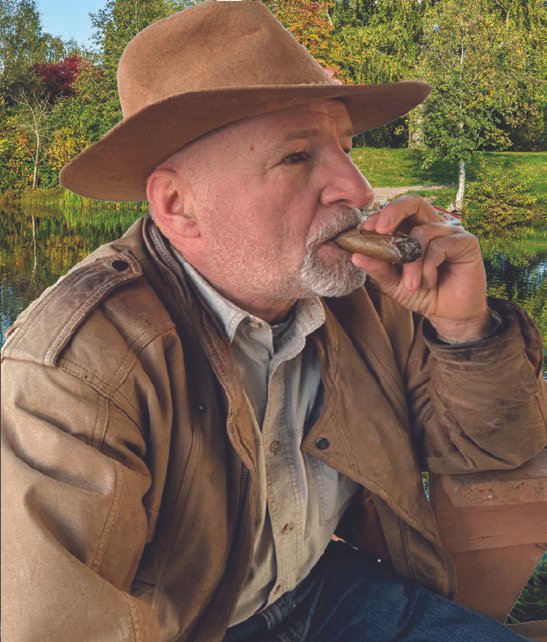
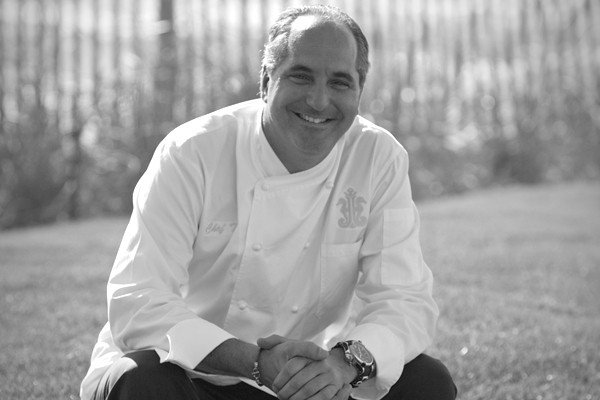
Chef Philippe Parola wearing a brown hat and smoking a cigar — photograph from the book’s back cover
A message from Chef Philippe

Welcome to
Can’t Beat’em, Eat’Em!

Fish, wild boar and nutria movement logo

Welcome to Can’t Beat’em, Eat’Em!

Thank you for visiting our website and joining us in exploring a new approach to invasive species.

Our mission is to educate and inspire people to discover how many invasive species can become delicious, nutritious sources of natural protein for families and communities. As food costs continue to rise and hunger affects people locally and around the world, we believe it is important to pursue practical, sustainable solutions.

Invasive species can threaten ecosystems, but many also represent an underused source of food. Alongside efforts to control their populations, we can support solutions—including processing facilities—that transform suitable invasive species into convenient, accessible food for the family table.

On this website, you can learn the stories behind these species, explore recipes, and discover how to safely prepare and cook them for your friends and family.

Together, we can turn an ecological challenge into a culinary opportunity and make a difference one bite at a time.

Making a difference one bite at a time!

A culinary pioneer since the early 1980s

A lifetime of seeing
opportunity in the overlooked.

EARLY 1980s · ALLIGATOR

From wasted meat
to the menu.

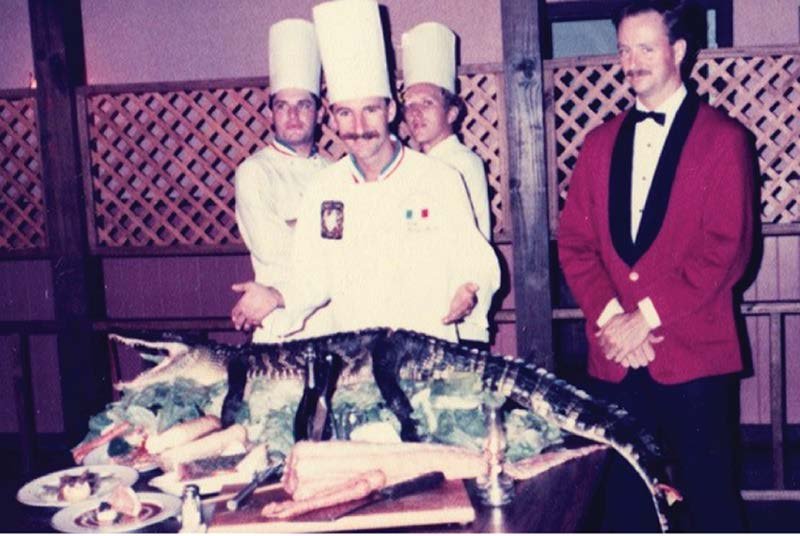
Chef Philippe’s early alligator cooking work

Chef Philippe developed recipes and promoted alligator meat when the hides were valued but the meat often went unused. His work helped introduce an underutilized native resource to American diners.

1990s · NUTRIA

A culinary response
to wetland damage.
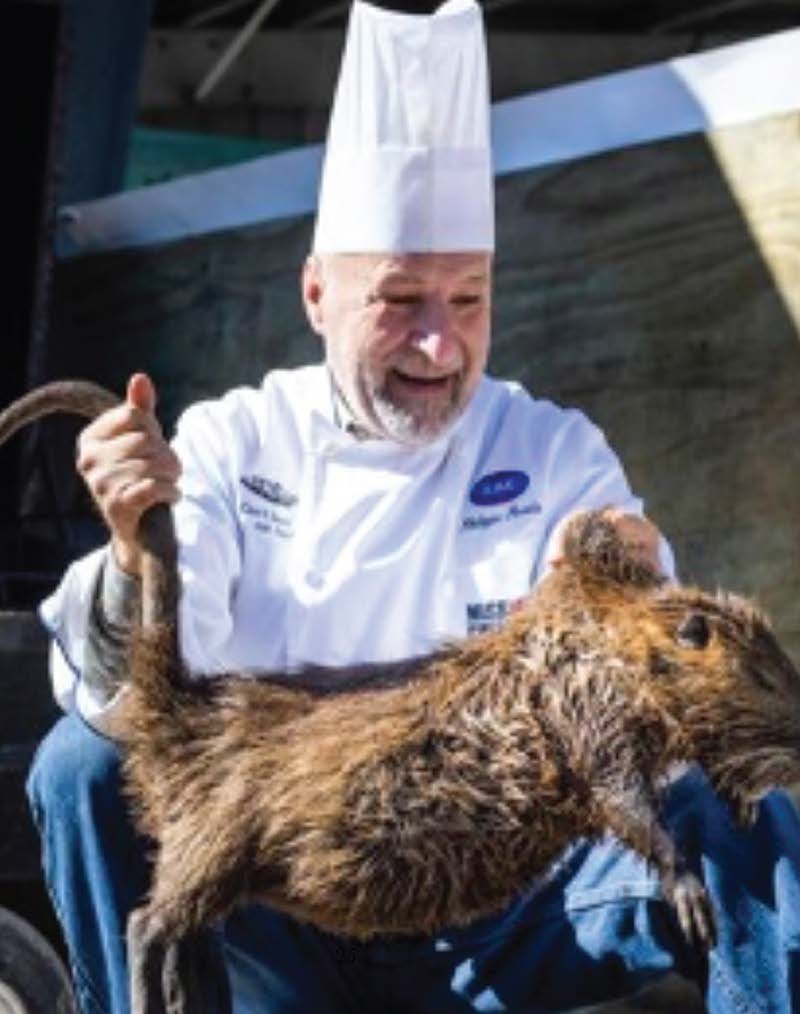
Chef Philippe with nutria, photographed in his book

The Louisiana Department of Wildlife and Fisheries enlisted Chef Philippe to promote nutria meat. He and fellow Louisiana chefs showed how this invasive species could become food while encouraging harvest.

2009 ONWARD · INVASIVE CARP

Building a market.
Advancing a mission.

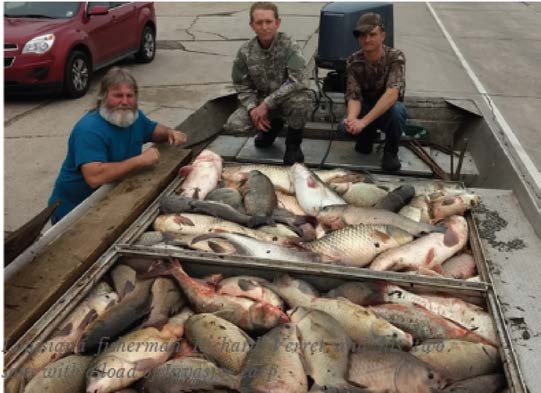
Commercial invasive carp harvest pictured in Chef Philippe’s book

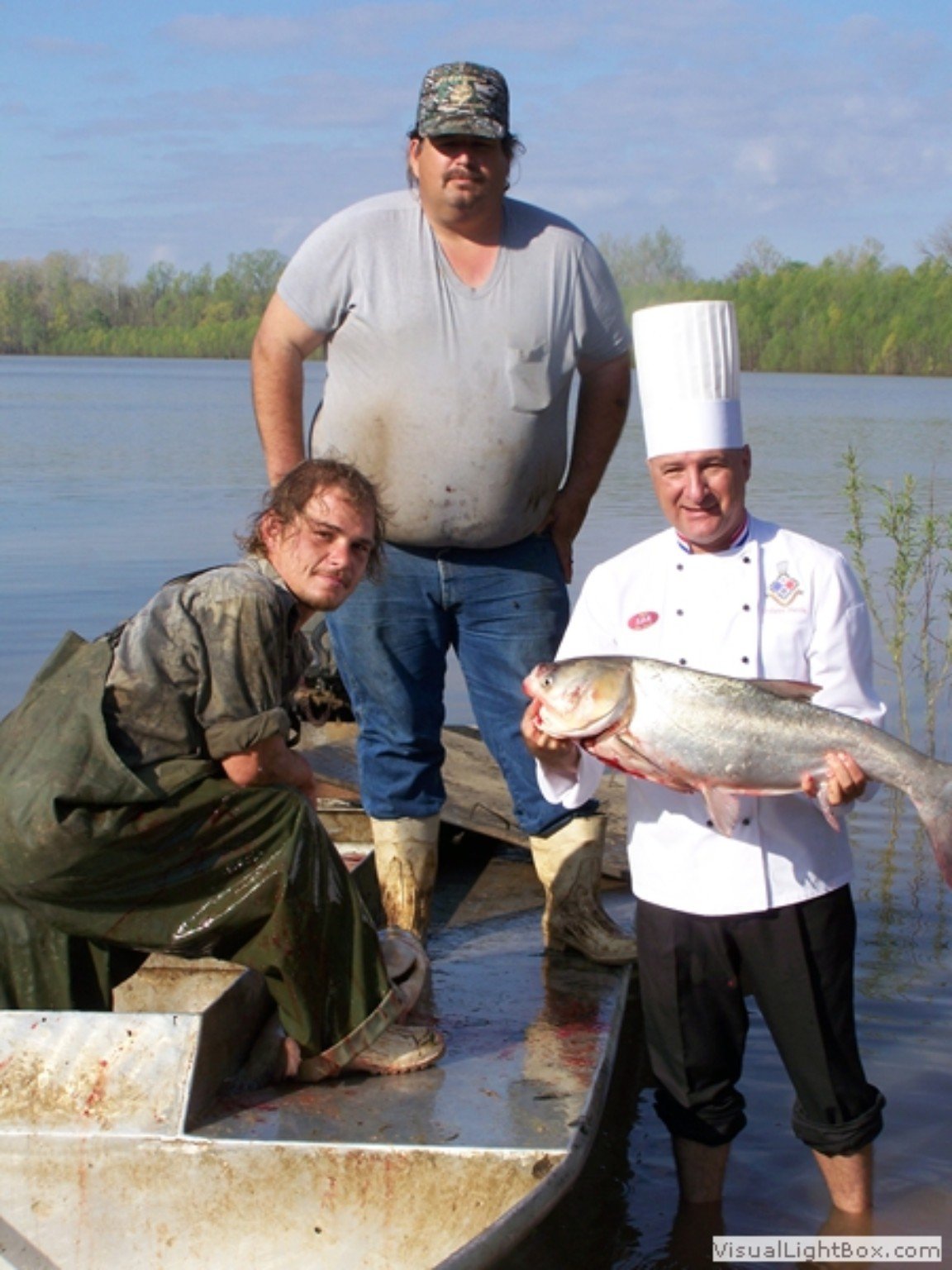
Beginning with an encounter on the Atchafalaya River, Chef Philippe developed recipes and processing protocols, trained teams, and brought a carp product to market in 2019. Today, that mission continues with Copi.

Read Chef Philippe’s full story

Chef Philippe Parola

Ecological Culinary Innovator

Book Author - Consultant - Speaker

Chef Philippe Parola is the founder of the Can't Beat'em, Eat'Em movement and author of the book of the same name. His work brings together culinary creativity, public education, and the development of markets for edible invasive species.

Based in Louisiana, he has focused on turning invasive species—including invasive carp, wild boar, and nutria—into culinary opportunities. His approach connects the kitchen with a larger mission: helping protect native ecosystems by encouraging responsible use of invasive resources.

A culinary pioneer: from alligator to nutria to Copi

Chef Philippe’s work with underutilized natural resources began in Louisiana in the early 1980s. His book, Can’t Beat’em, Eat’Em, tells the story of how that work grew into a lasting culinary and ecological mission.

Alligator — bringing an overlooked resource to America’s menus. When businessman Egon Klein asked him to develop recipes using alligator meat, Chef Philippe accepted the challenge. At a time when hides were commercially valuable but meat often went to waste, he created dishes and promoted alligator as a culinary delicacy. His work helped develop appreciation for the meat and demonstrated how cooking could create value from an underused resource. Alligators are native to Louisiana; this chapter of his career concerned resource use and managed wildlife populations.
Nutria — promoting food use to support wetland protection. Building on his alligator work, the Louisiana Department of Wildlife and Fisheries enlisted Chef Philippe in the 1990s to promote nutria meat. With processing guidelines developed through cooperation with the Louisiana Department of Agriculture, the effort connected culinary promotion with an urgent ecological problem: invasive nutria consuming vegetation and damaging coastal wetlands. Other Louisiana chefs joined him, introducing nutria in preparations such as sausages, stews, and gumbos under the message “Can’t Beat’em, Eat’Em!”

Invasive carp / Copi — pioneering a new food market. In 2009, while preparing for a Food Network filming opportunity on Louisiana’s Atchafalaya River, Chef Philippe encountered invasive carp and recognized their potential as food. He committed nearly a decade to overcoming barriers to commercial use, including their complex bone structure and public reluctance to eat carp. He developed fish-cake recipes and processing protocols, traveled to Vietnam to train processing teams, and brought an invasive carp product to the American market in 2019. Today, his Copi work continues that mission through product development, consulting, and efforts to establish U.S. processing opportunities that connect commercial harvest with food production, jobs, and ecosystem protection.

These milestones establish Chef Philippe as a pioneer in cooking and promoting underutilized natural resources. They are the foundation of his work today as an Ecological Culinary Innovator, book author, and consultant.

Chef Philippe works as a consultant to project owners, operators, and partners. He helps shape products, processing concepts, market positioning, and outreach so that ecological purpose and commercial practicality can work together.

Historical photographs and accounts from Can’t Beat’em, Eat’Em, printed pages 12–18. Alligator is native to Louisiana; nutria and invasive carp are invasive species.

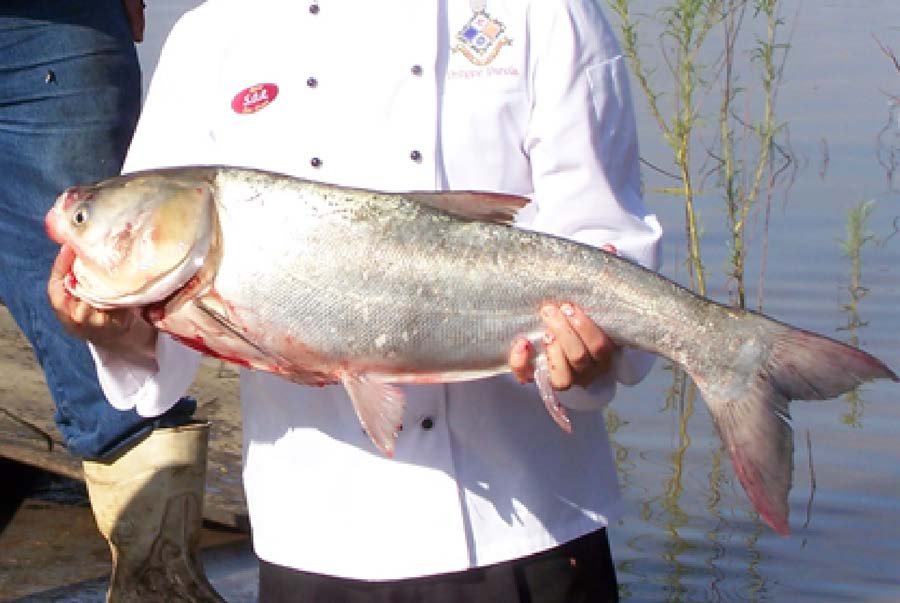
Silver carp shown in the book
From ecological challenge to culinary opportunity

Discover Copi.

Silver, bighead, grass, and black carp: four invasive carp species with opportunities for food development and responsible commercial harvest.

Copi Select
Premium Minced Carp

Versatile minced fish for fish cakes, sliders, patties, and food-service applications. Chef Philippe connects culinary development with processing concepts and market opportunities.

Request product information
Food service, processing, and partnerships

Copi: culinary innovation with an ecological purpose

Copi is the name used here for invasive carp: silver, bighead, grass, and black carp. Chef Philippe's work focuses on creating value from these fish through food development, processing concepts, and market connections.

Copi Select — Premium Minced Carp

Copi Select is a minced-fish product concept designed for versatile preparation. Minced Copi can be developed into fish cakes, sliders, patties, and other convenient dishes.

Chef Philippe's approach focuses on taste, usability, and a clear connection to the ecological purpose behind the product.

Opportunities for food service

Potential partners include colleges and universities, institutional dining programs, distributors, and food-service operators interested in introducing Copi products and telling the story behind their ingredients.

Chef Philippe can help partners explore recipes, menu applications, product positioning, and educational outreach.

Processing and byproduct opportunities

A practical processing project needs outlets for more than its primary food product. Chef Philippe helps project teams explore potential uses for suitable byproducts, including pet-food ingredients and other value-added applications, subject to technical feasibility, buyer specifications, and applicable requirements.

Projects and partnerships

Chef Philippe welcomes discussions with project owners, processing operators, harvesters, buyers, and investment partners exploring invasive carp commercialization.

From vision to reality

A vast river basin.
A practical opportunity.

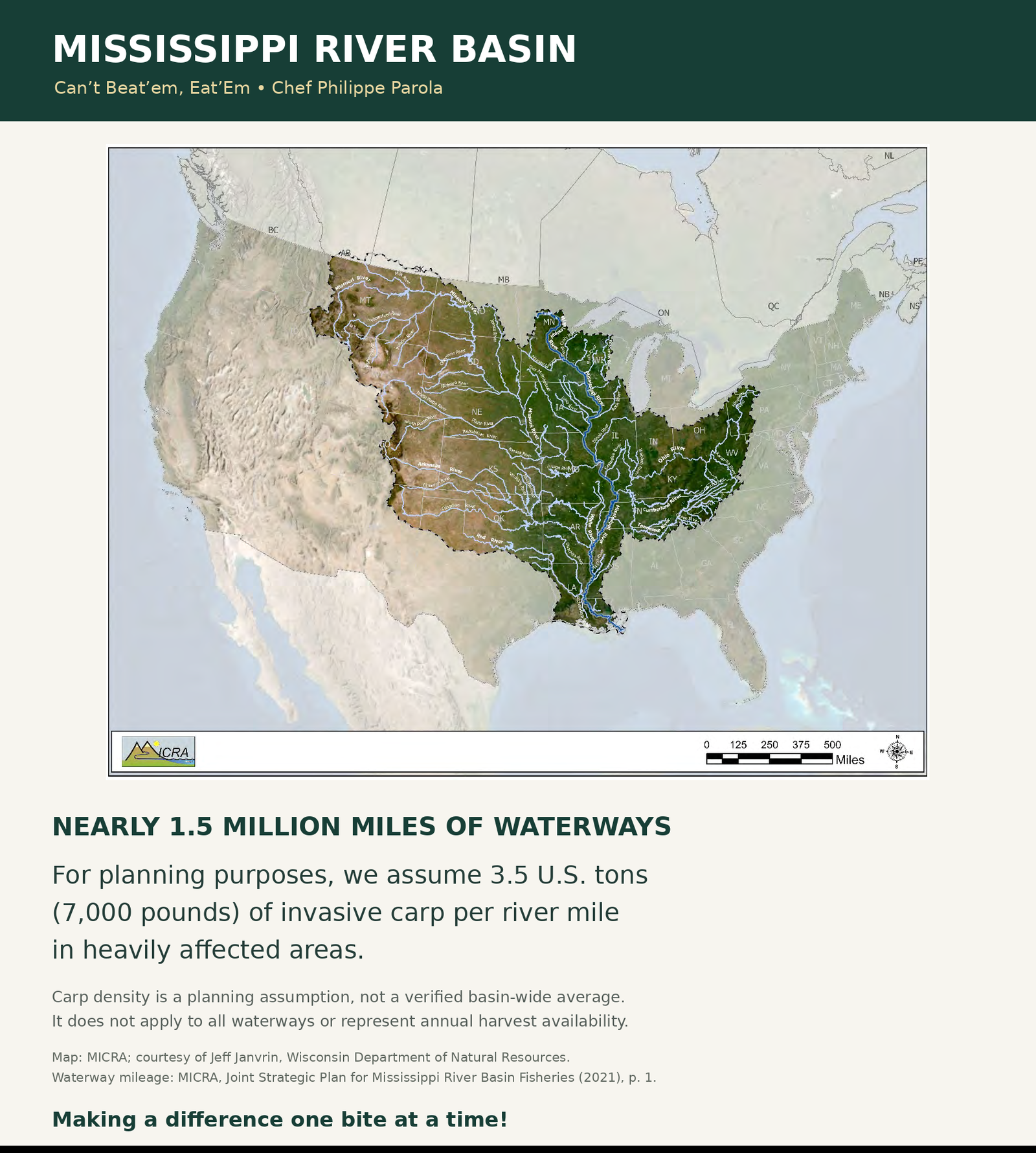
The Mississippi River Basin encompasses nearly 1.5 million miles of waterways. Chef Philippe’s proposed processing network connects harvest in affected waterways with food production, jobs, and opportunities for fishermen.

Mississippi River Basin map, nearly 1.5 million miles of waterways; carp density of 3.5 U.S. tons per river mile is a planning assumption for heavily affected areas

Tap either illustration to enlarge. The basin shading is not a carp distribution map. Waterway mileage: MICRA’s 2021 Joint Strategic Plan, page 1. Map courtesy of Jeff Janvrin, Wisconsin Department of Natural Resources, via MICRA.

Yes We Can!

Transforming invasive fish into food products for human consumption—creating jobs, supporting fishermen, and helping protect our ecosystems.

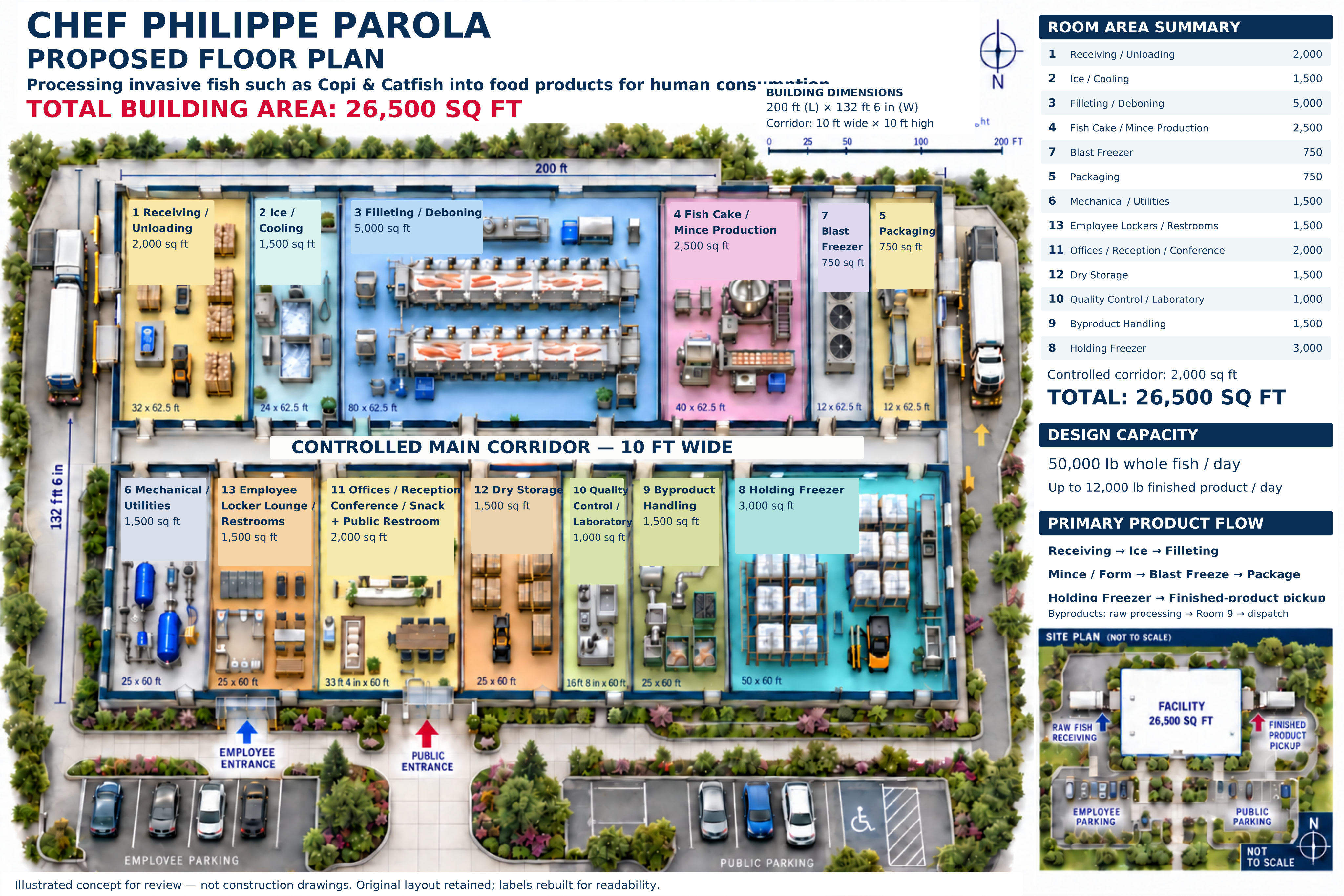
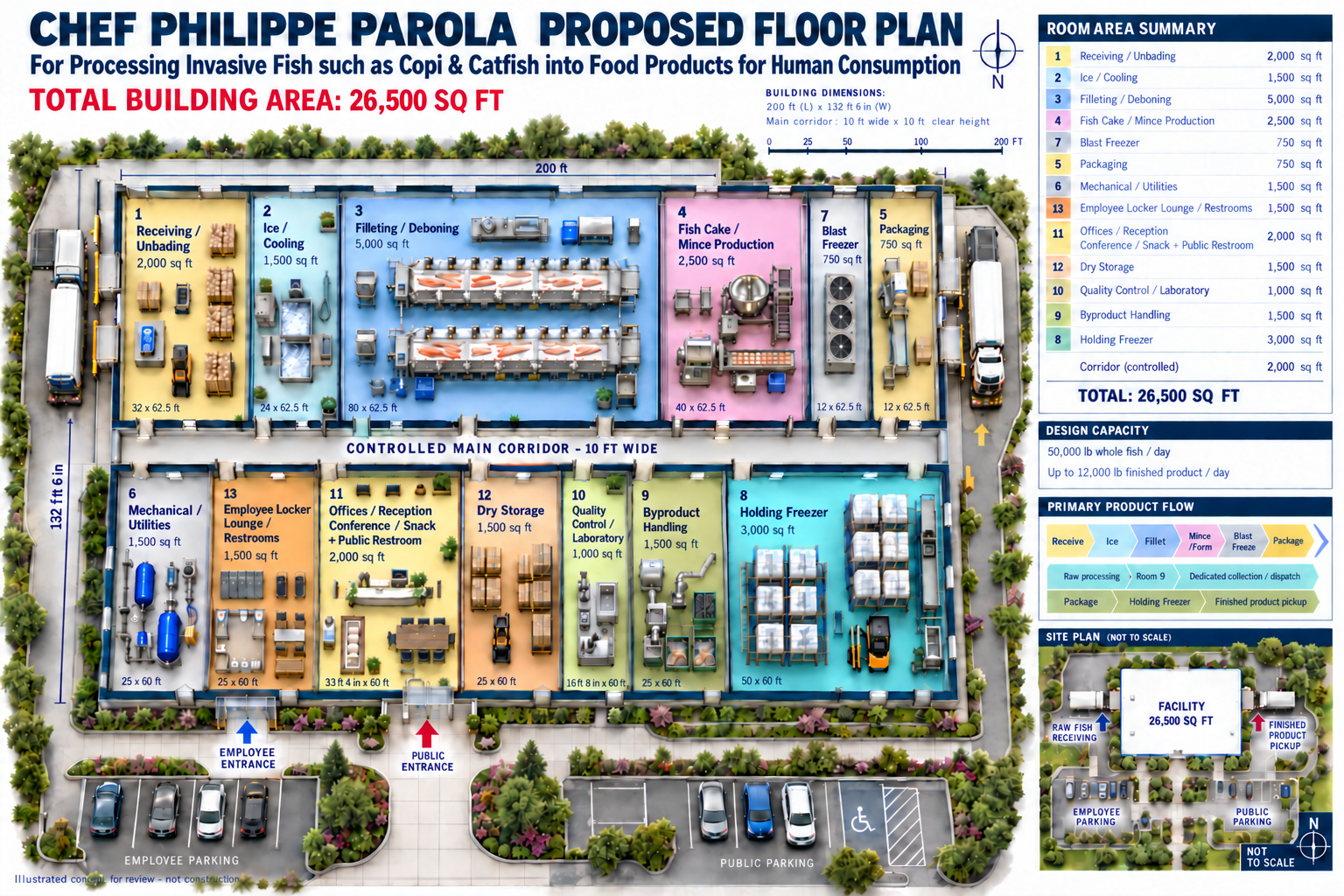
Chef Philippe Parola’s proposed processing facility brings together receiving, filleting, mincing, forming, freezing, packaging, storage, and byproduct handling.

Chef Philippe Parola proposed floor plan for processing invasive fish such as Copi and catfish into food products for human consumption

Proposed Facility Concept · 26,500 square feet · 50,000 pounds of whole fish per day · Up to 12,000 pounds of finished product per day.

Planning targets subject to engineering, equipment selection, and operating validation. Concept illustration, not construction drawings. Catfish status depends on species and harvest location.

Beyond fish: invasive mammals

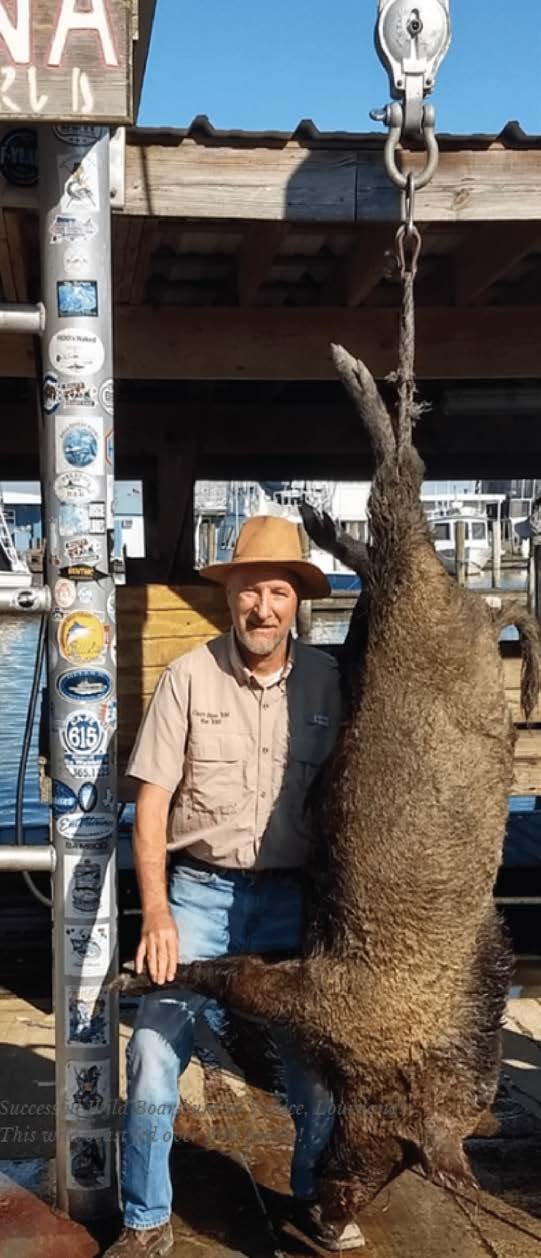
The same concept can be adapted for suitable invasive mammals such as wild pigs, with separate facilities, equipment, handling, and inspection arrangements designed for each species.

Chef Philippe serves as a consultant to project owners and operators, connecting product development, processing concepts, market opportunities, and public education.

Discuss a processing project

Making a difference one bite at a time!

Learn · Cook · Make a difference

Discover the stories.
Bring new ingredients to the table.

Explore the book’s fish, shellfish, mammals, birds, reptiles, amphibians, and plants. Species status varies by location; responsible sourcing begins with local identification and harvest guidance.

Silver carp

Invasive carp

Developing appealing food products can create demand for harvest from affected waterways.

Nutria promotion

Nutria

Chef Philippe’s Louisiana promotion connected cooking with protection of coastal wetlands.

Wild boar pictured in the book

Wild boar

Discover a different approach to an animal that damages landscapes and native habitats.

Explore the recipe collection
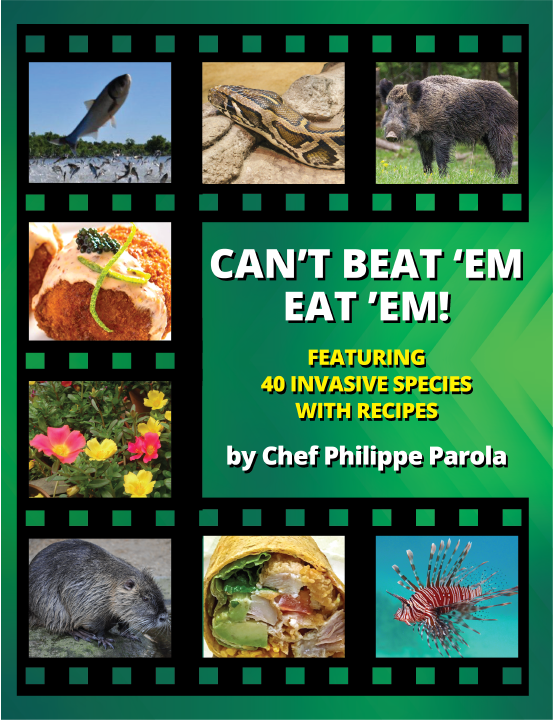
Can’t Beat’em, Eat’Em book cover
The book by Chef Philippe Parola

40 invasive species.
A world of culinary possibilities.

Recipes, species stories, and a practical connection between food and ecological action.

$49Includes U.S. shipping · Signed by Chef Philippe
Request a signed book by emailAsk about a signed copy

Email Chef Philippe to arrange your signed book order and payment. Include the autograph recipient. International and group orders: contact Chef Philippe.

From the original book

Open the kitchen.

Browse 43 recipes, presented as original book pages to preserve quantities, directions, and contributor credits. Search by dish or ingredient in the recipe title.

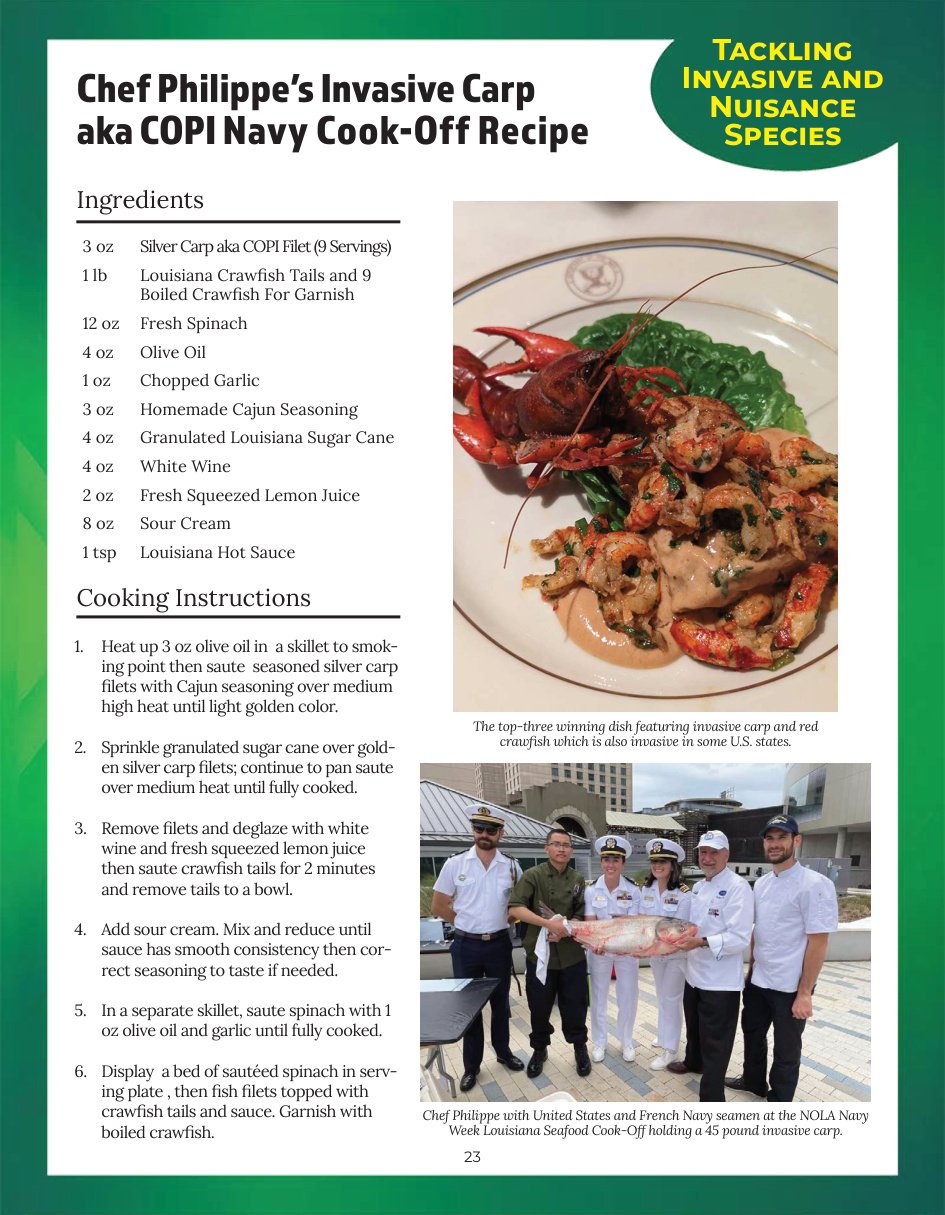
Chef Philippe’S Invasive Carp Aka Copi Navy Cook-Off RecipeFish · Book page 23Original recipe page: Chef Philippe’s Invasive Carp aka COPI Navy Cook-Off Recipe
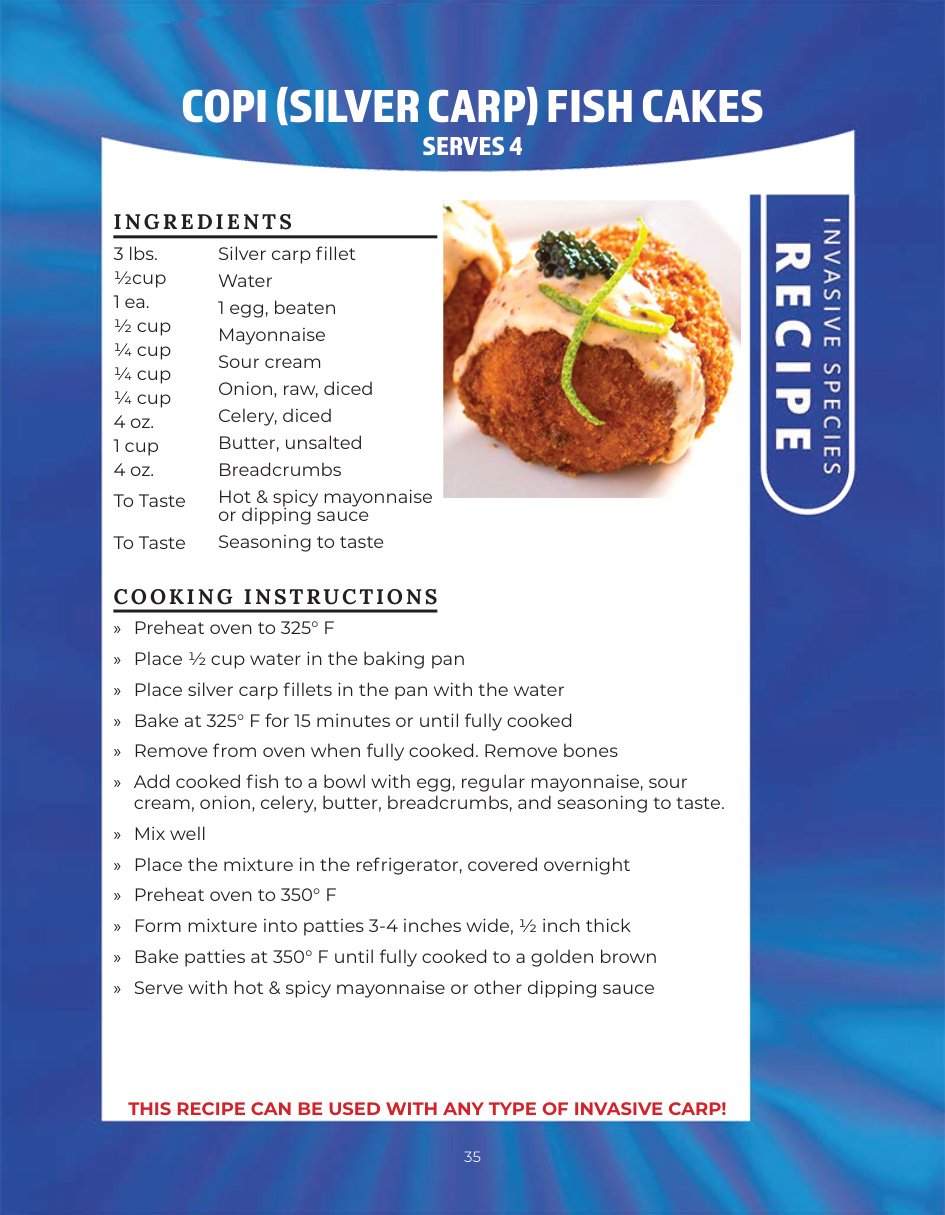
Copi (Silver Carp) Fish CakesFish · Book page 35Original recipe page: COPI (SILVER CARP) FISH CAKES
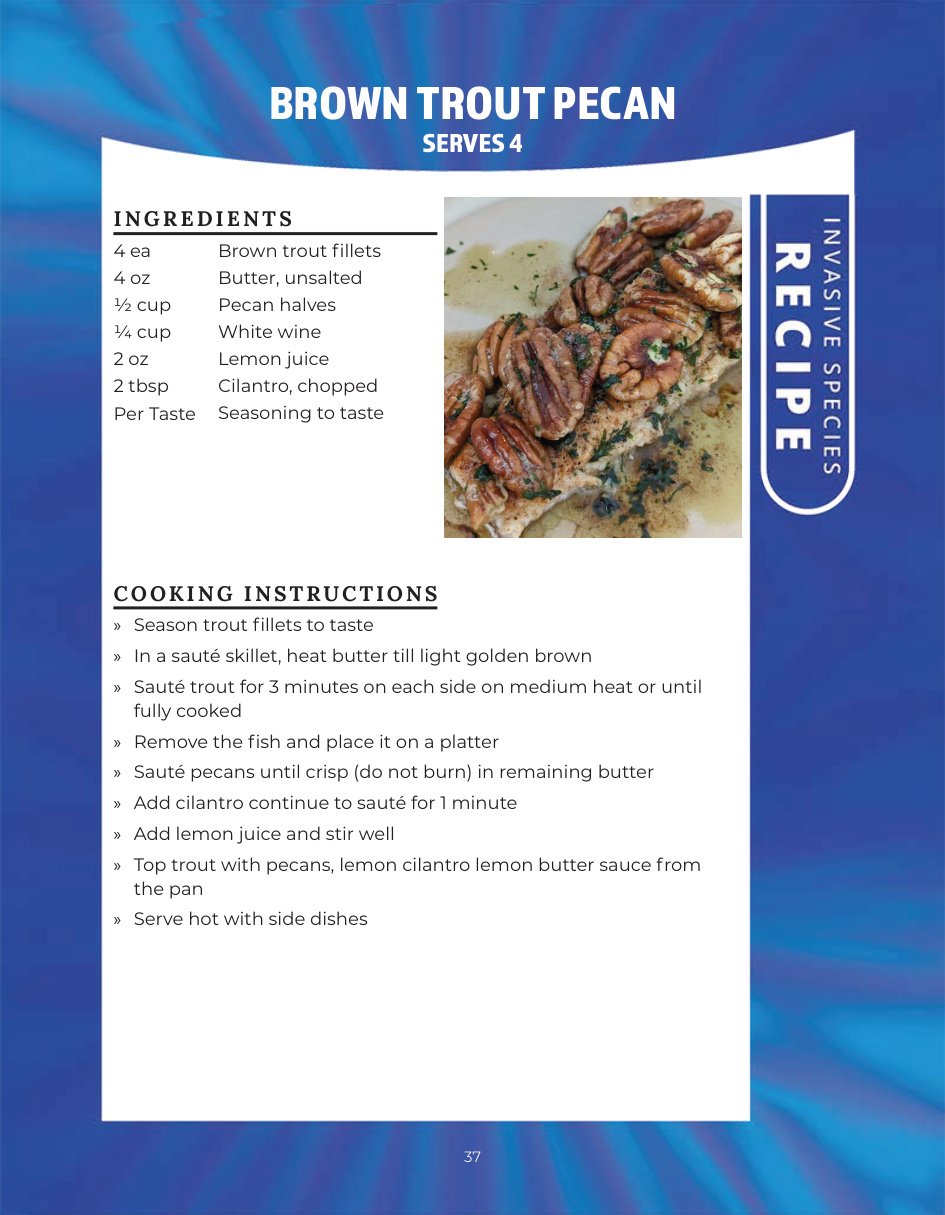
Brown Trout PecanFish · Book page 37Original recipe page: BROWN TROUT PECAN
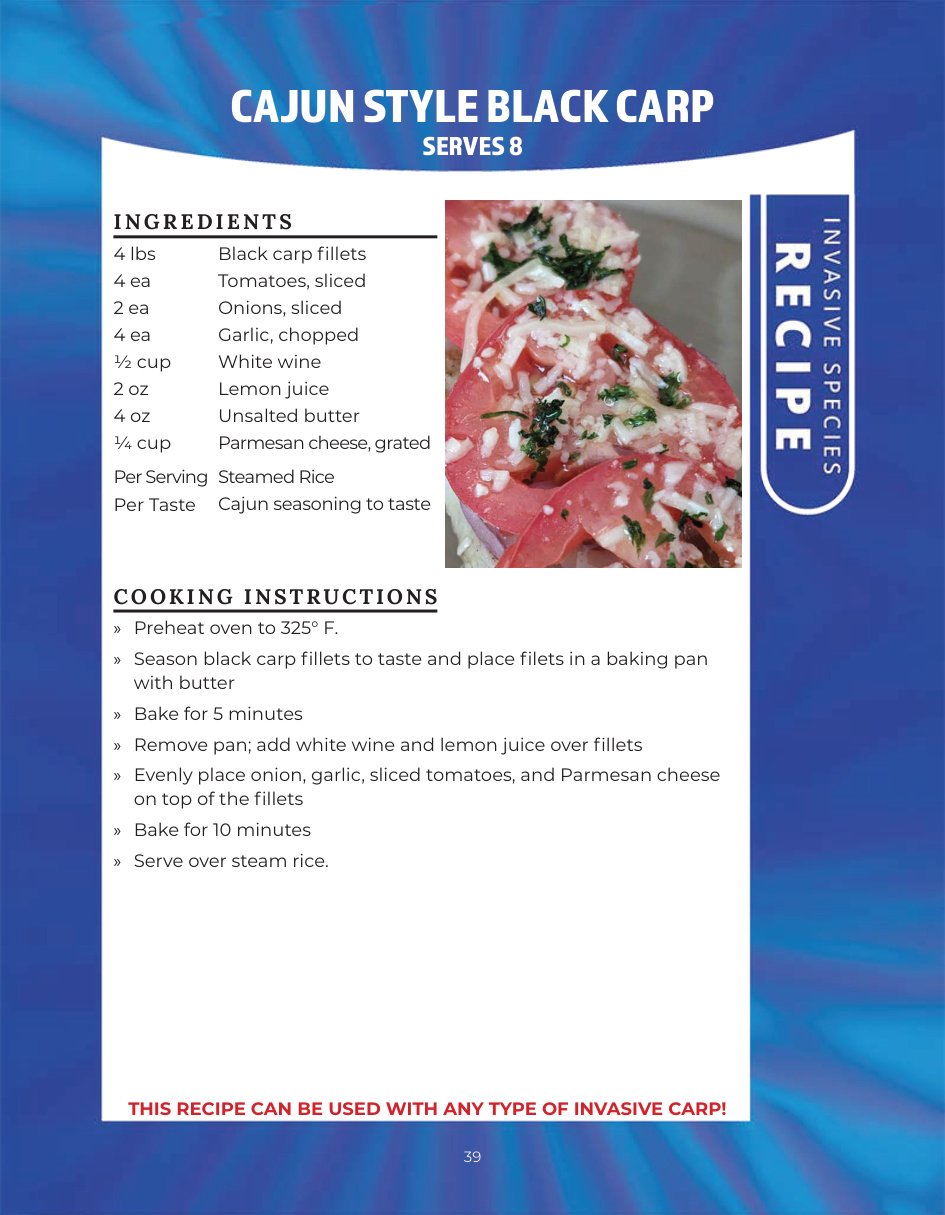
Cajun Style Black CarpFish · Book page 39Original recipe page: CAJUN STYLE BLACK CARP
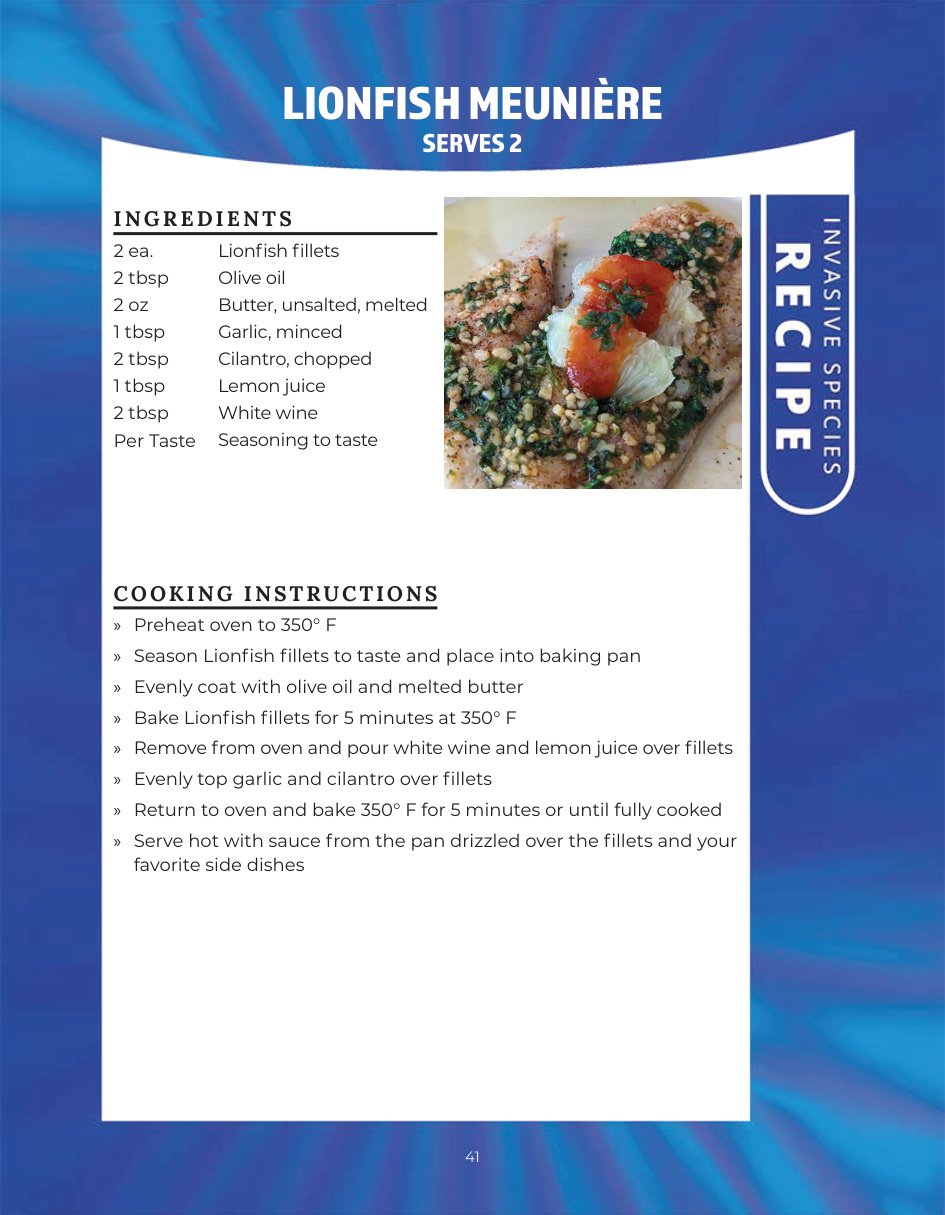
Lionfish MeunièreFish · Book page 41Original recipe page: LIONFISH MEUNIÈRE
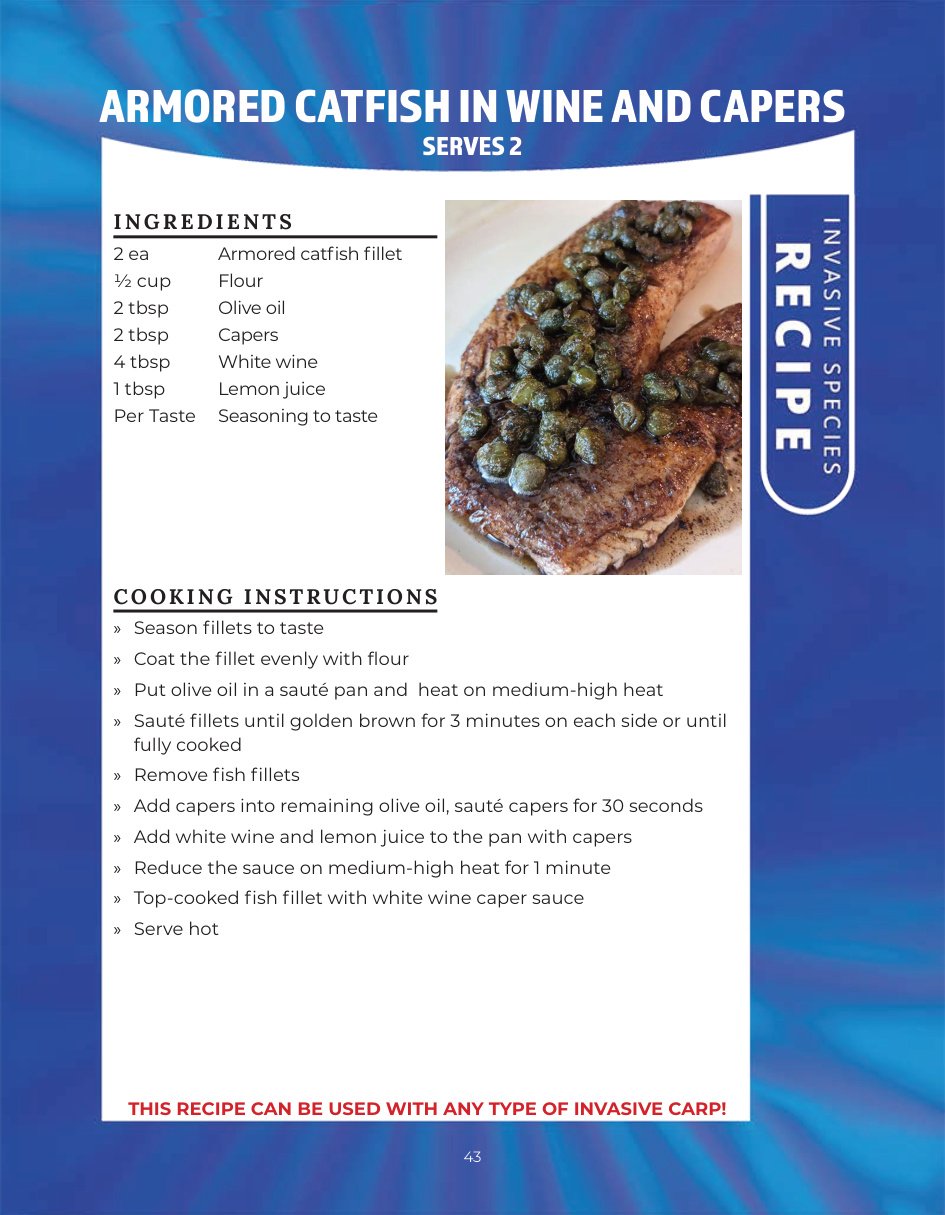
Armored Catfish In Wine And CapersFish · Book page 43Original recipe page: ARMORED CATFISH IN WINE AND CAPERS
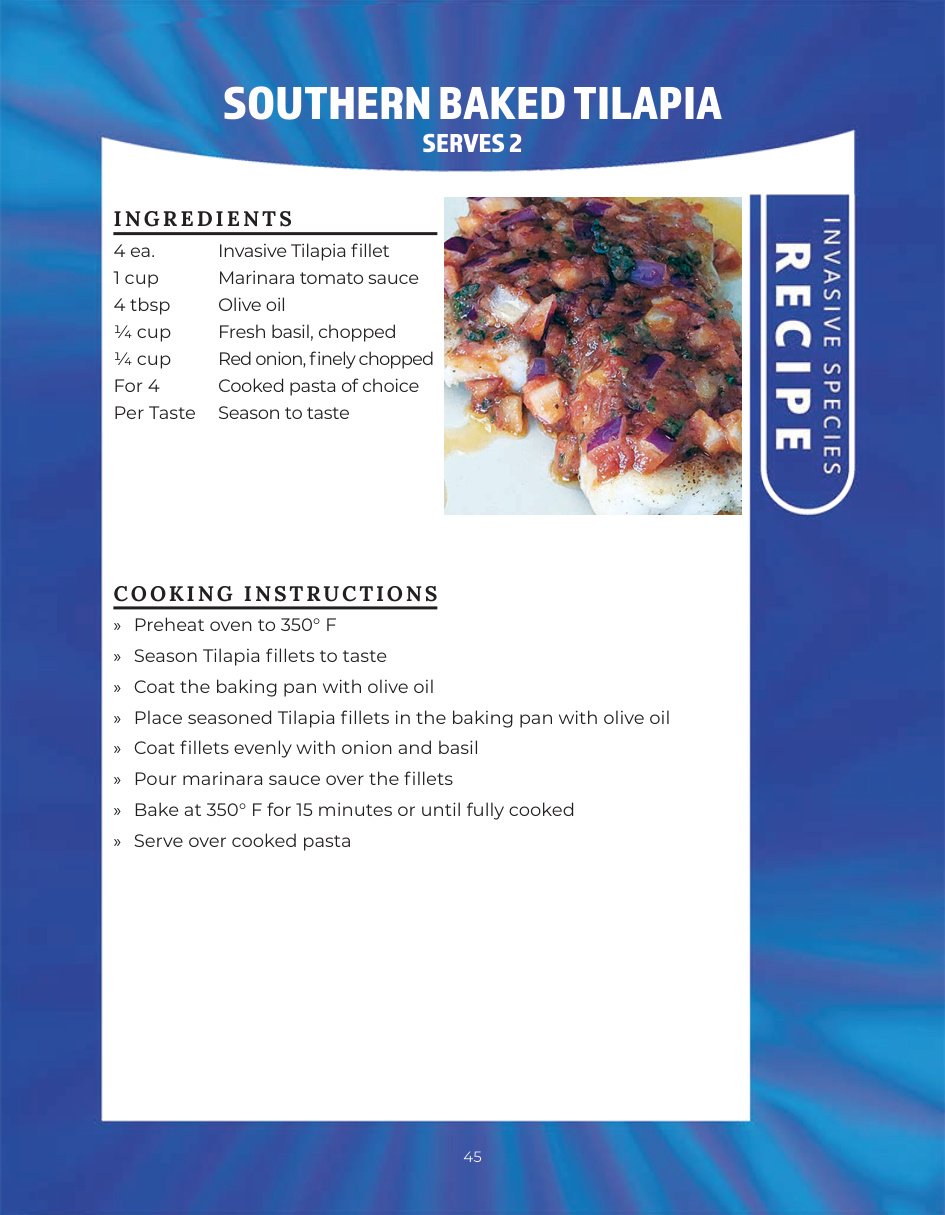
Southern Baked TilapiaFish · Book page 45Original recipe page: SOUTHERN BAKED TILAPIA
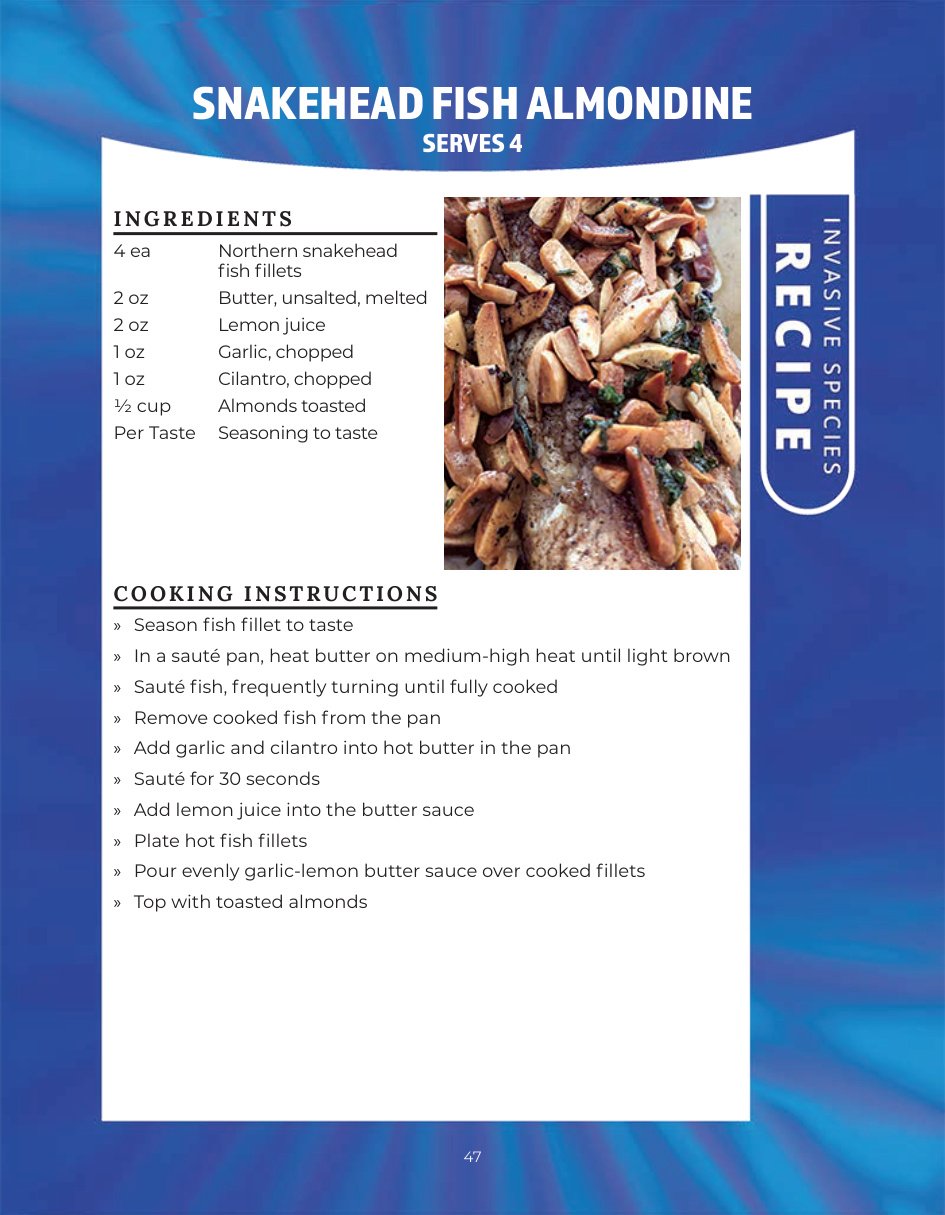
Snakehead Fish AlmondineFish · Book page 47Original recipe page: SNAKEHEAD FISH ALMONDINE
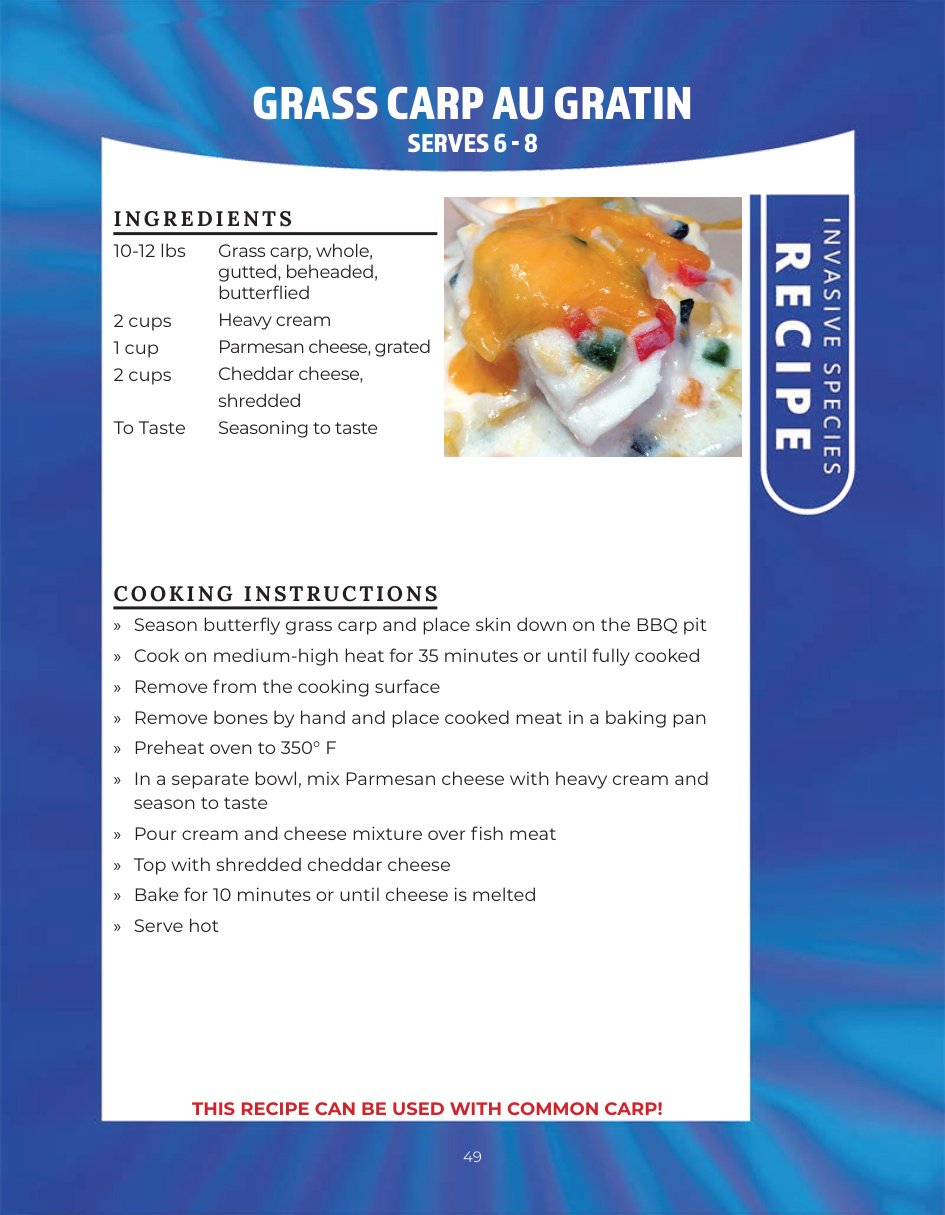
Grass Carp Au GratinFish · Book page 49Original recipe page: GRASS CARP AU GRATIN
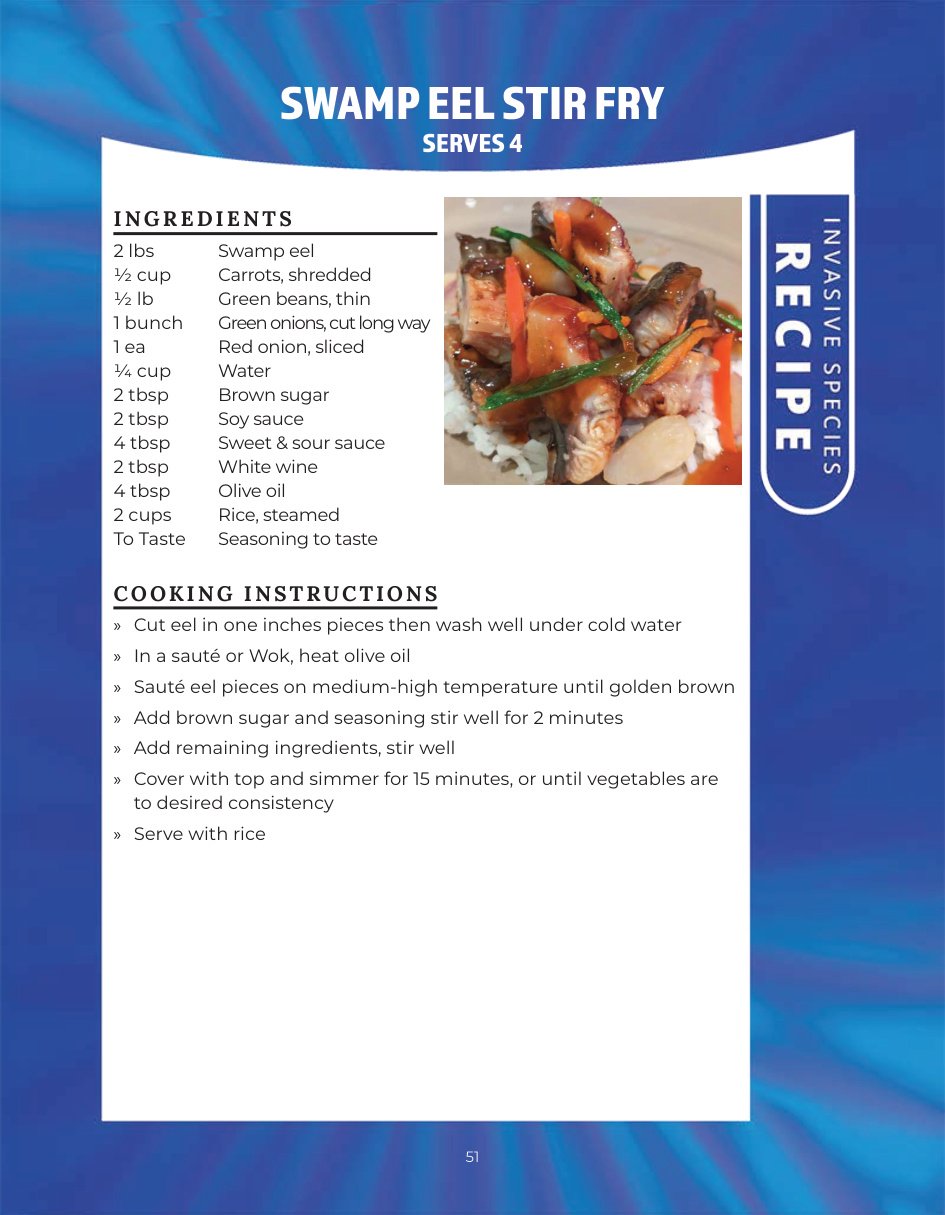
Swamp Eel Stir FryFish · Book page 51Original recipe page: SWAMP EEL STIR FRY
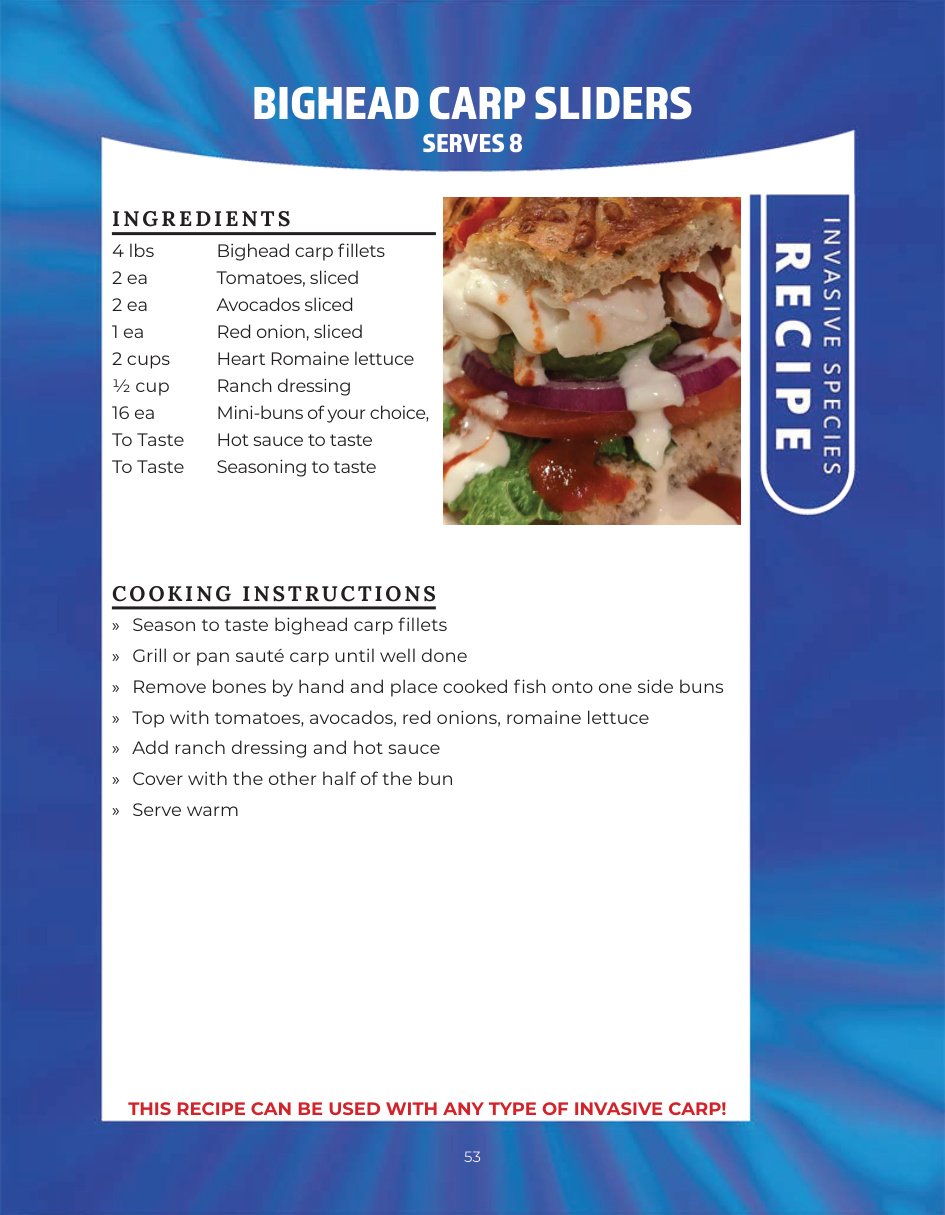
Bighead Carp SlidersFish · Book page 53Original recipe page: BIGHEAD CARP SLIDERS
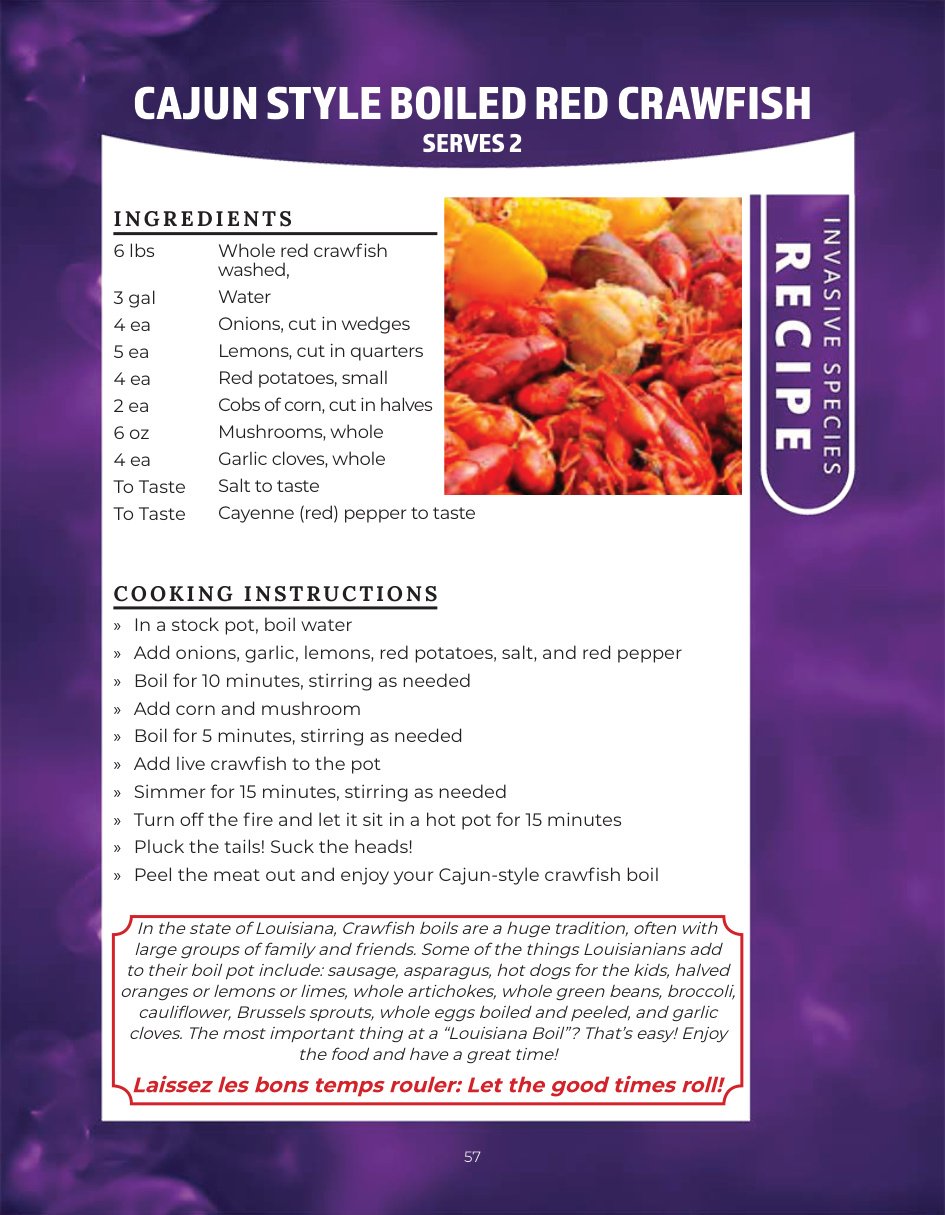
Cajun Style Boiled Red CrawfishShellfish · Book page 57Original recipe page: CAJUN STYLE BOILED RED CRAWFISH
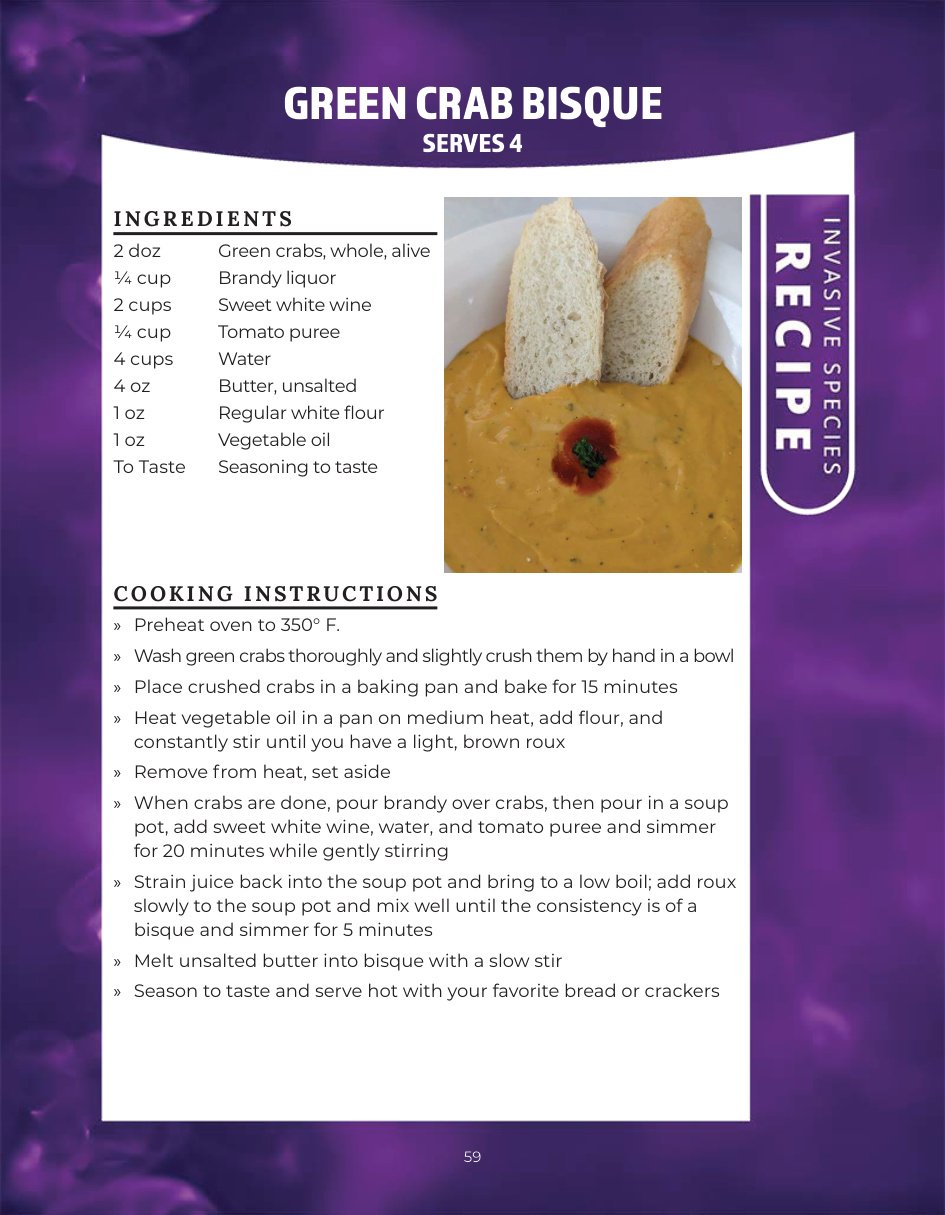
Green Crab BisqueShellfish · Book page 59Original recipe page: GREEN CRAB BISQUE
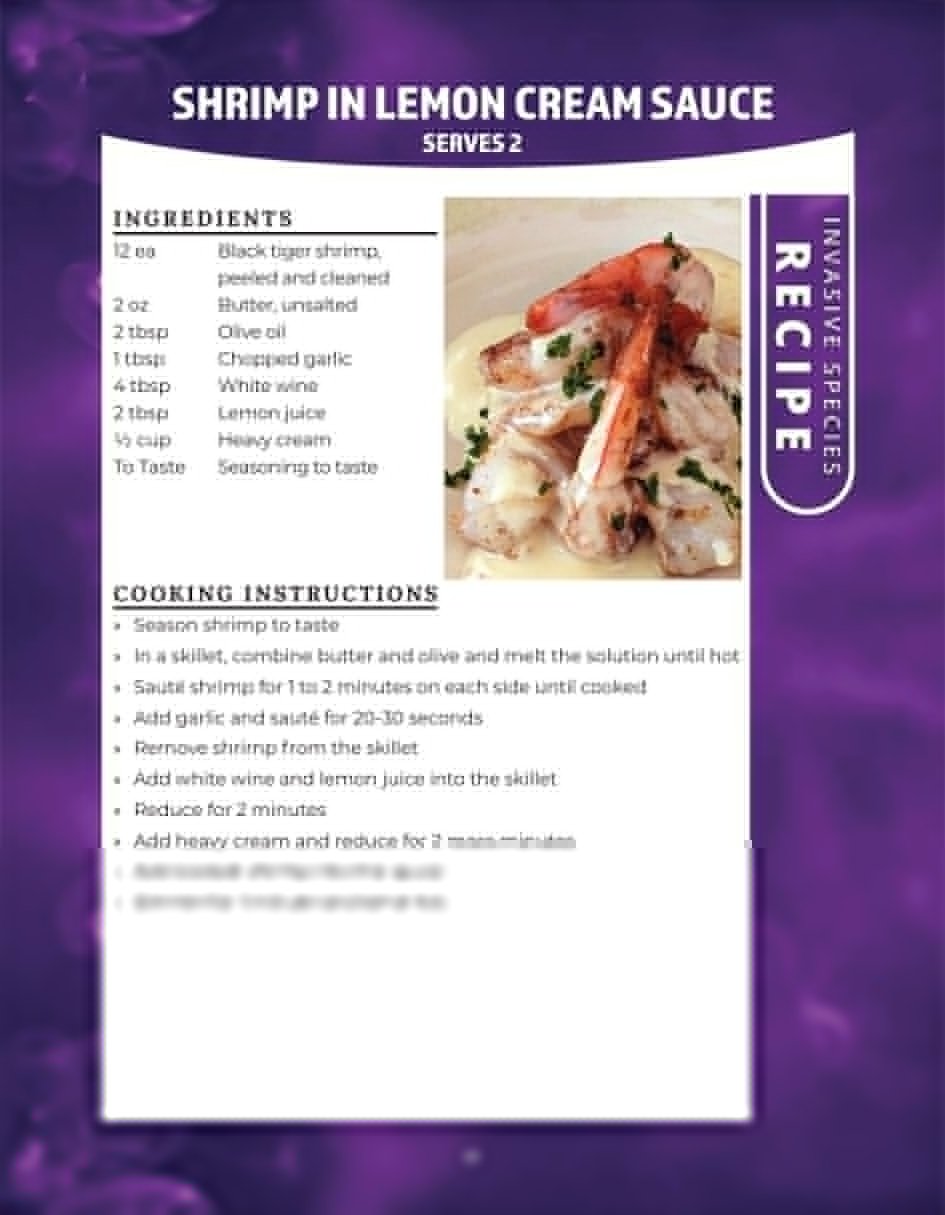
Shrimp In Lemon Cream SauceShellfish · Book page 61Original recipe page: SHRIMP IN LEMON CREAM SAUCE
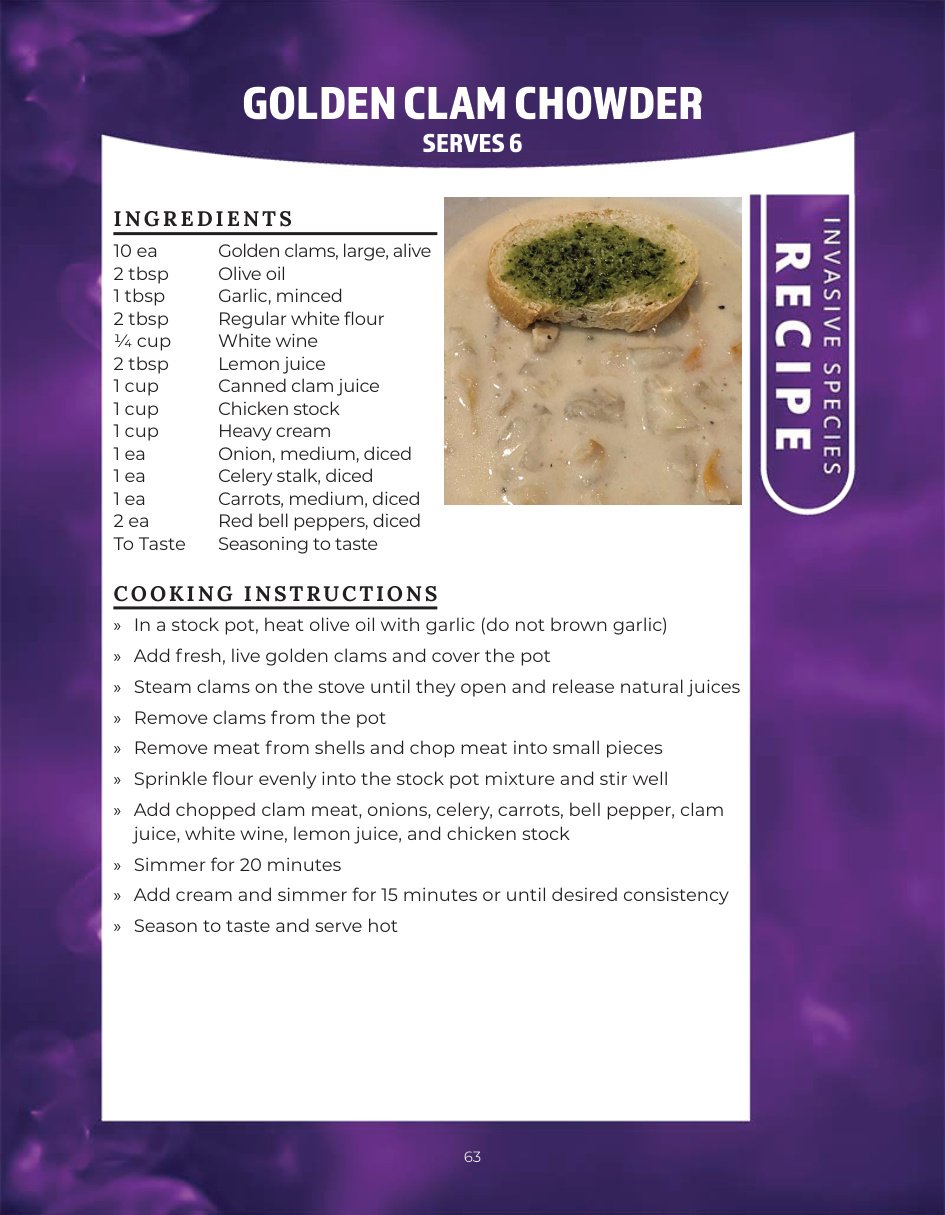
Golden Clam ChowderShellfish · Book page 63Original recipe page: GOLDEN CLAM CHOWDER
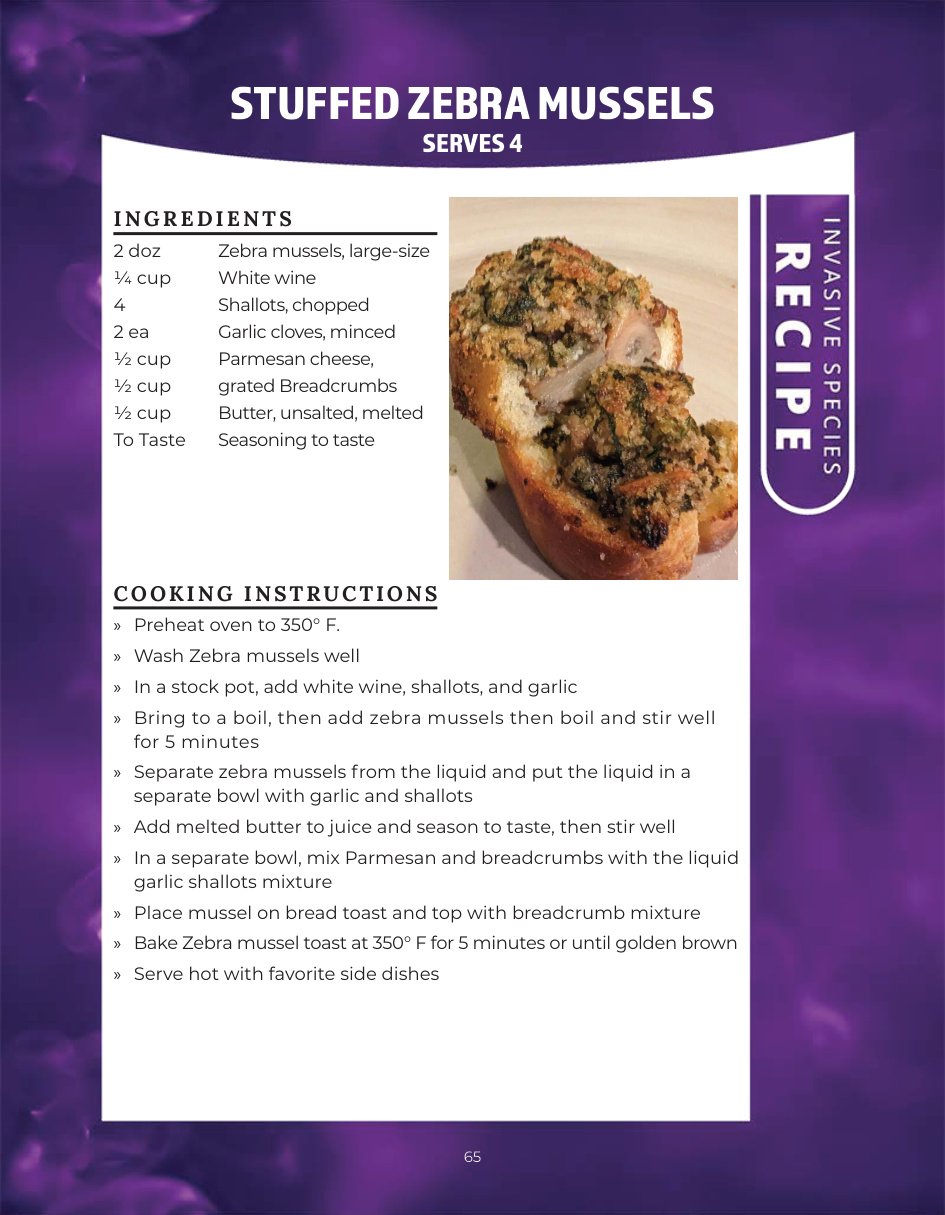
Stuffed Zebra MusselsShellfish · Book page 65Original recipe page: STUFFED ZEBRA MUSSELS
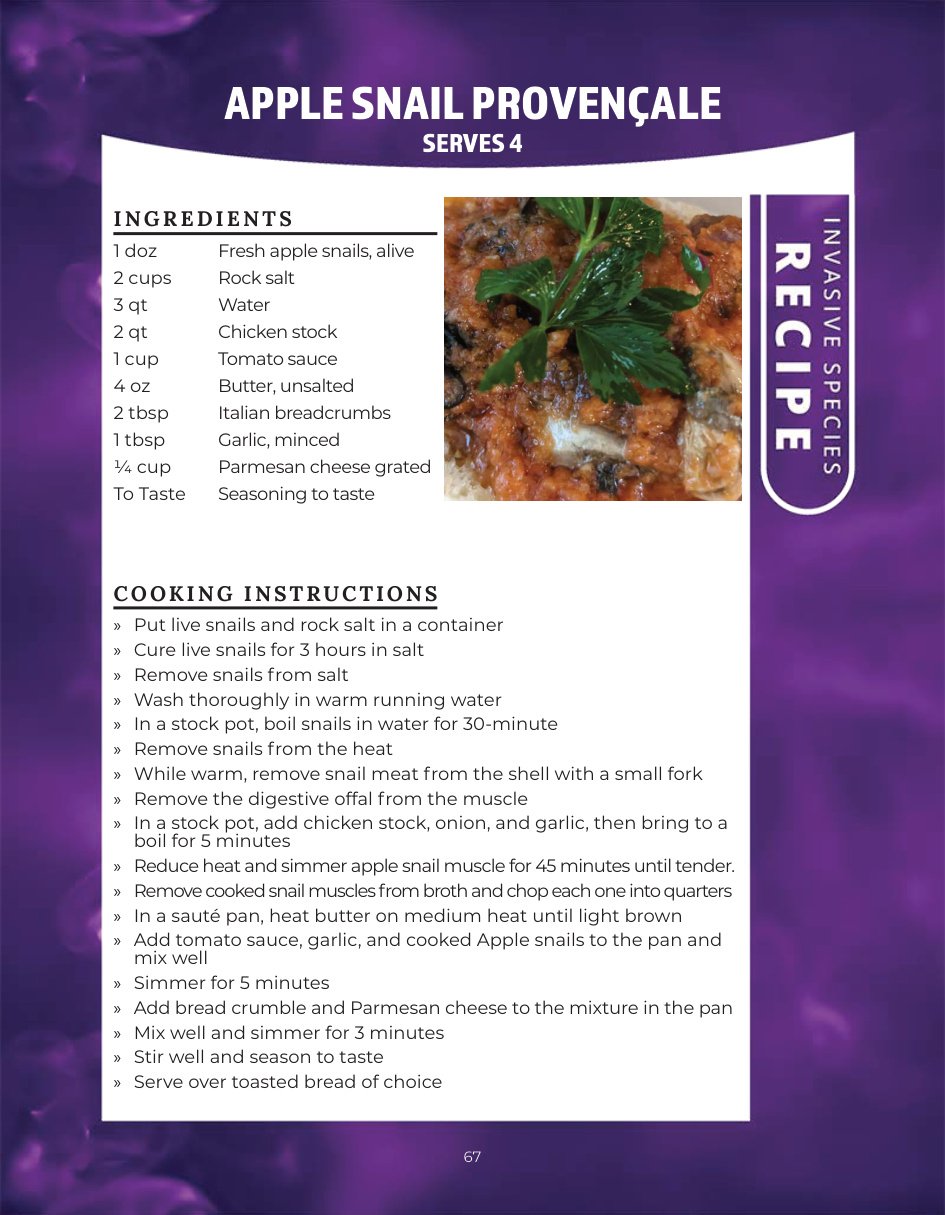
Apple Snail ProvençaleShellfish · Book page 67Original recipe page: APPLE SNAIL PROVENÇALE
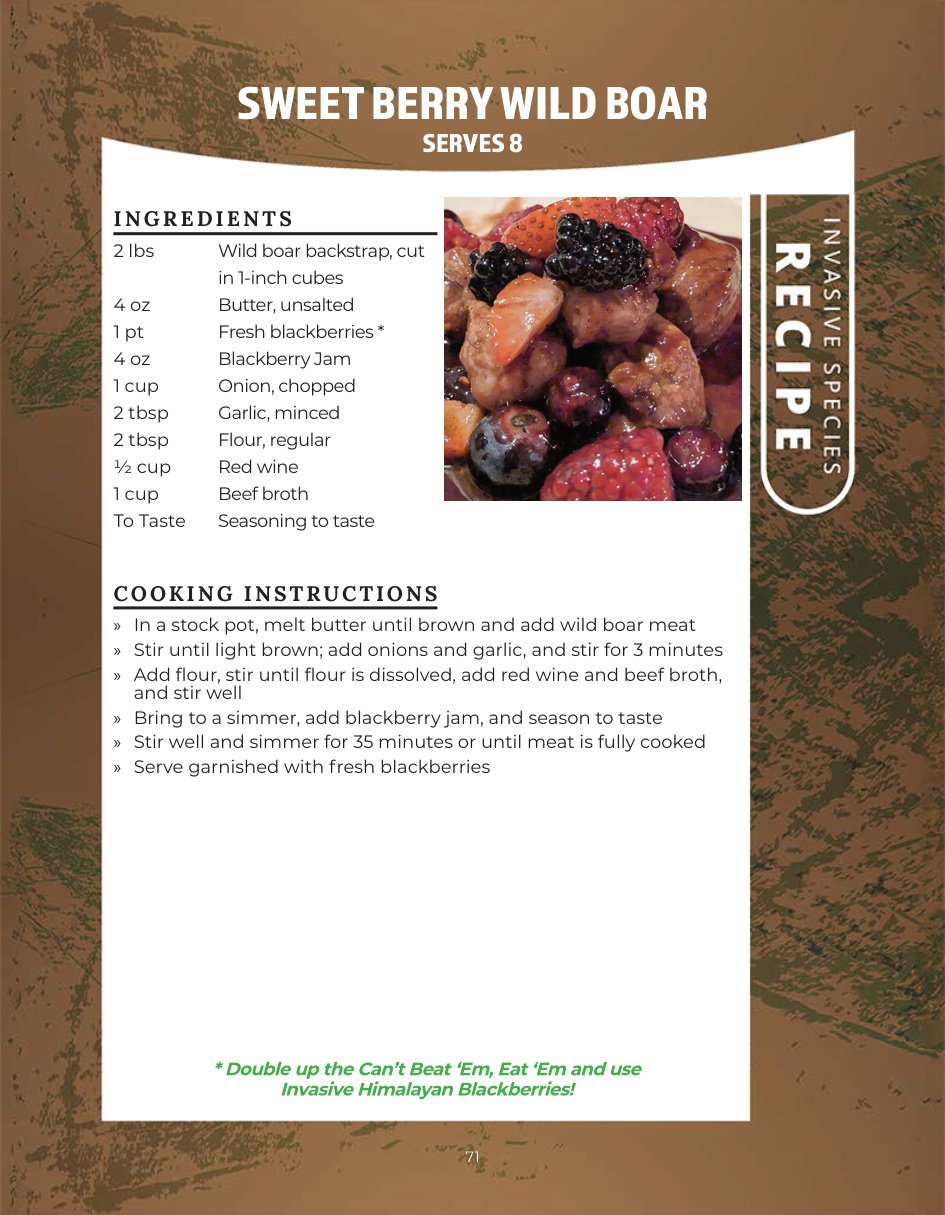
Sweet Berry Wild BoarMammals · Book page 71Original recipe page: SWEET BERRY WILD BOAR
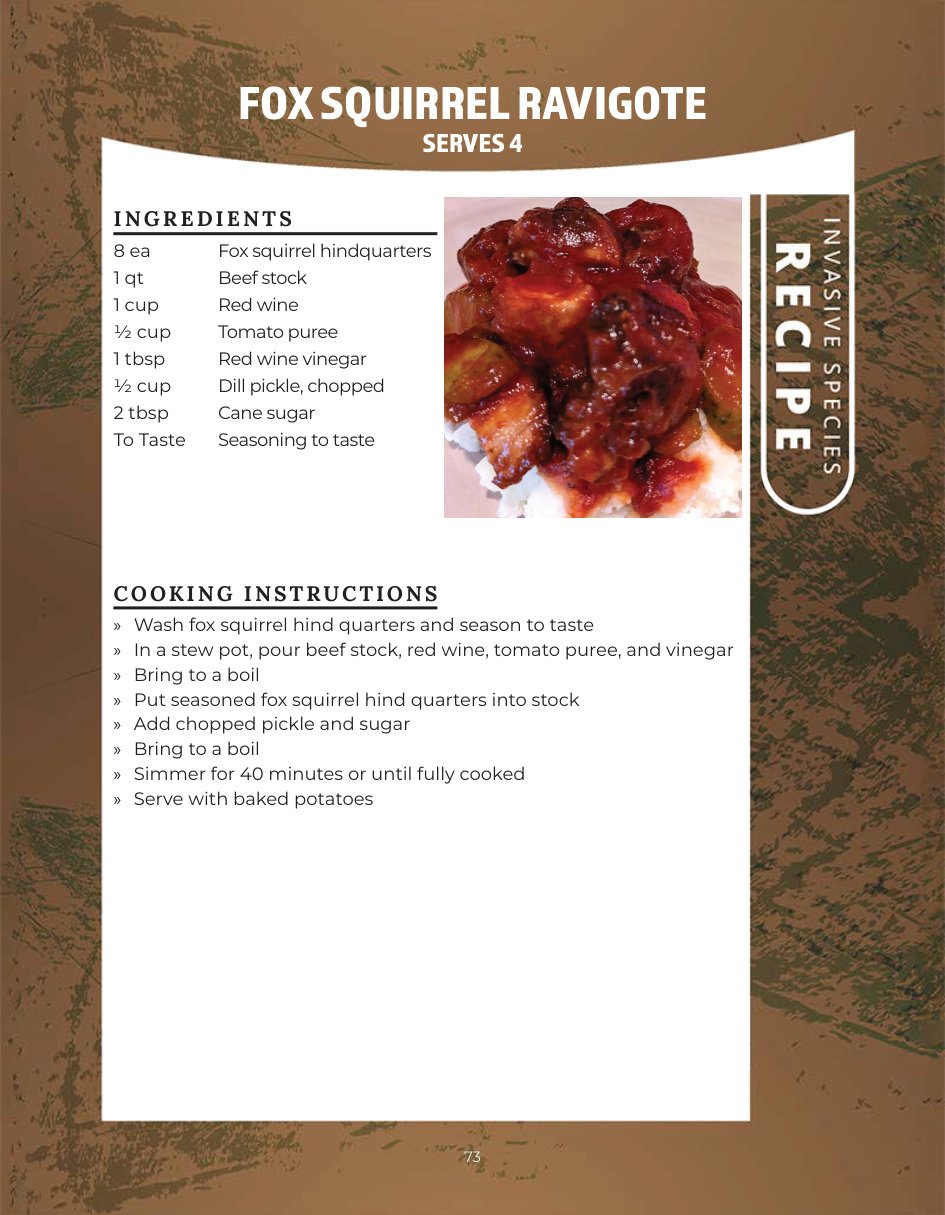
Fox Squirrel RavigoteMammals · Book page 73Original recipe page: FOX SQUIRREL RAVIGOTE
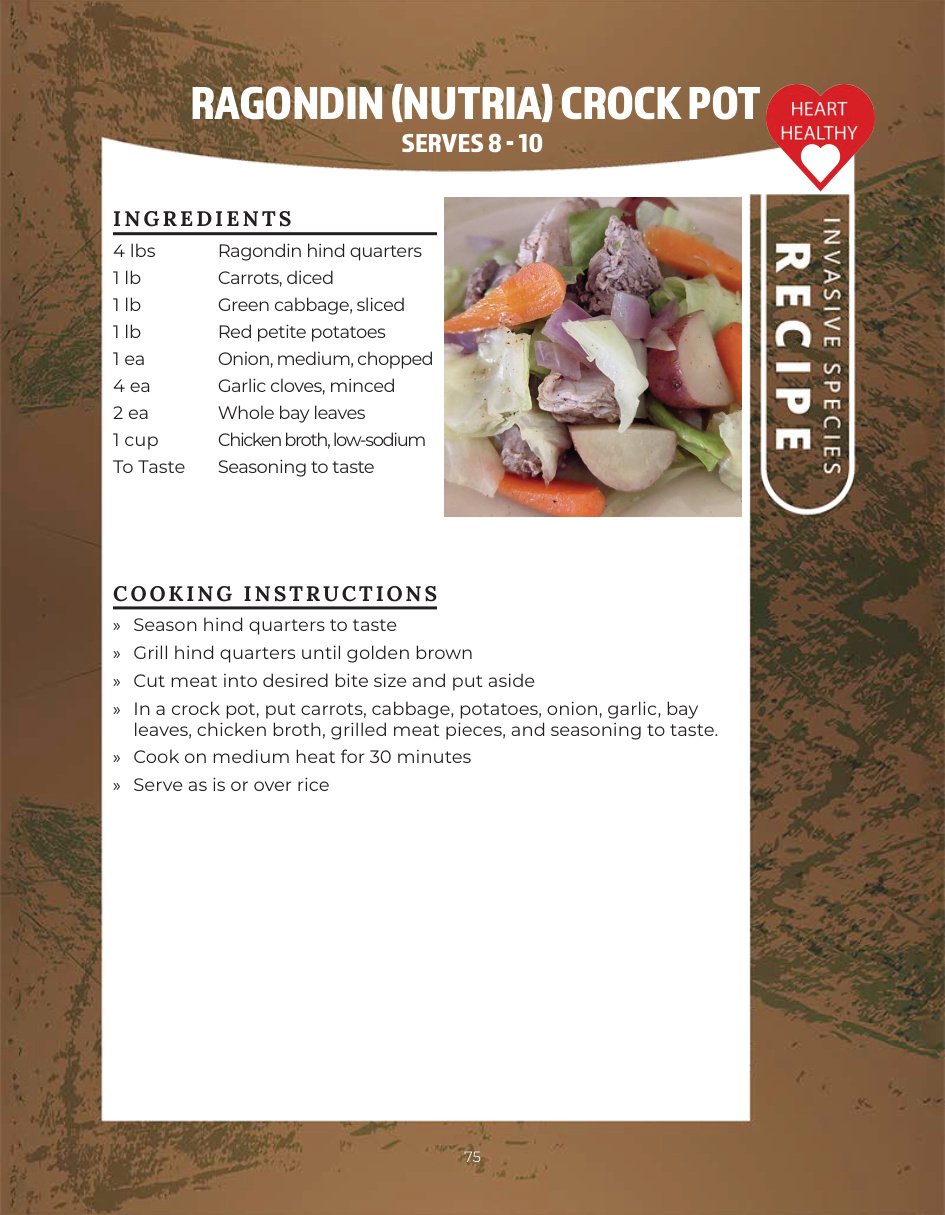
Ragondin (Nutria) Crock PotMammals · Book page 75Original recipe page: RAGONDIN (NUTRIA) CROCK POT
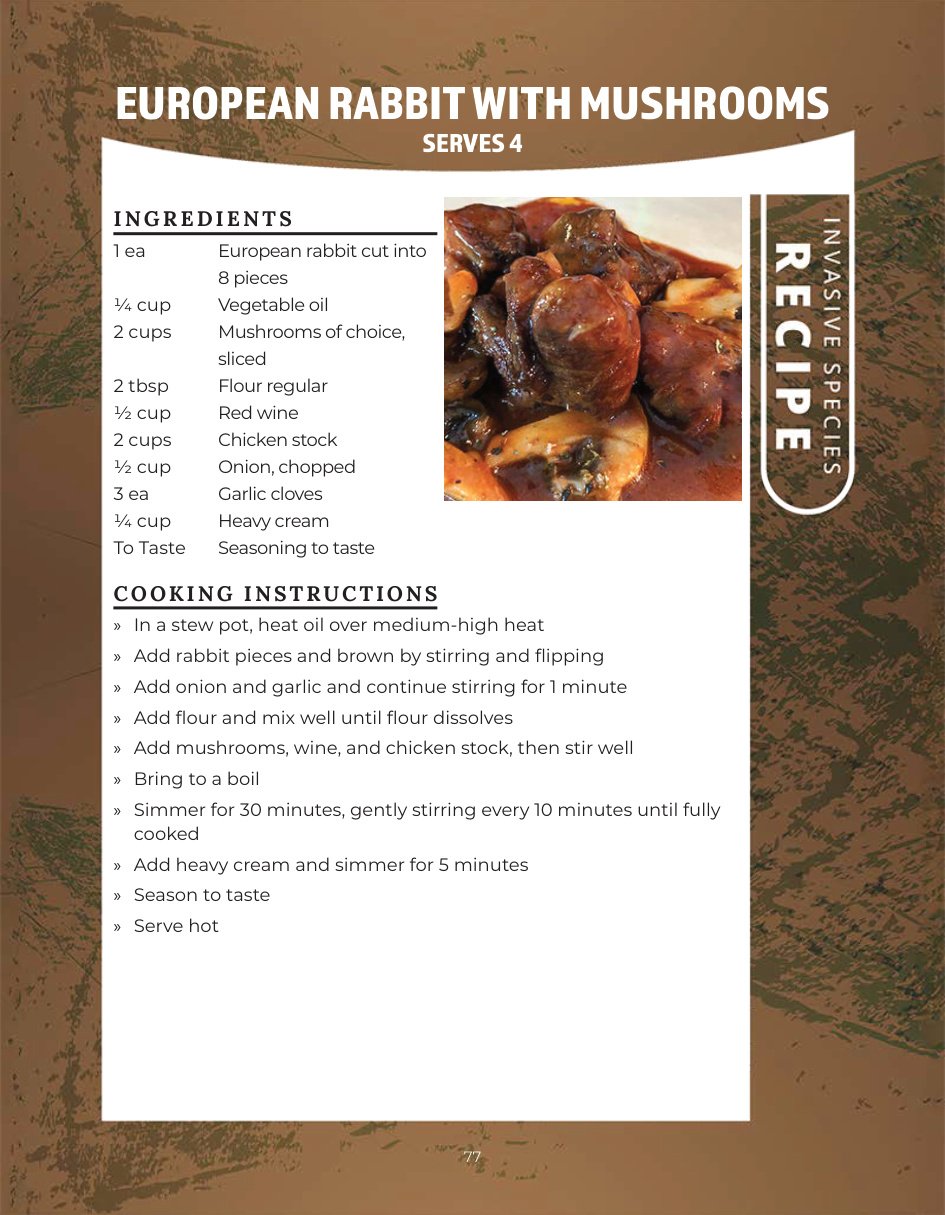
European Rabbit With MushroomsMammals · Book page 77Original recipe page: EUROPEAN RABBIT WITH MUSHROOMS
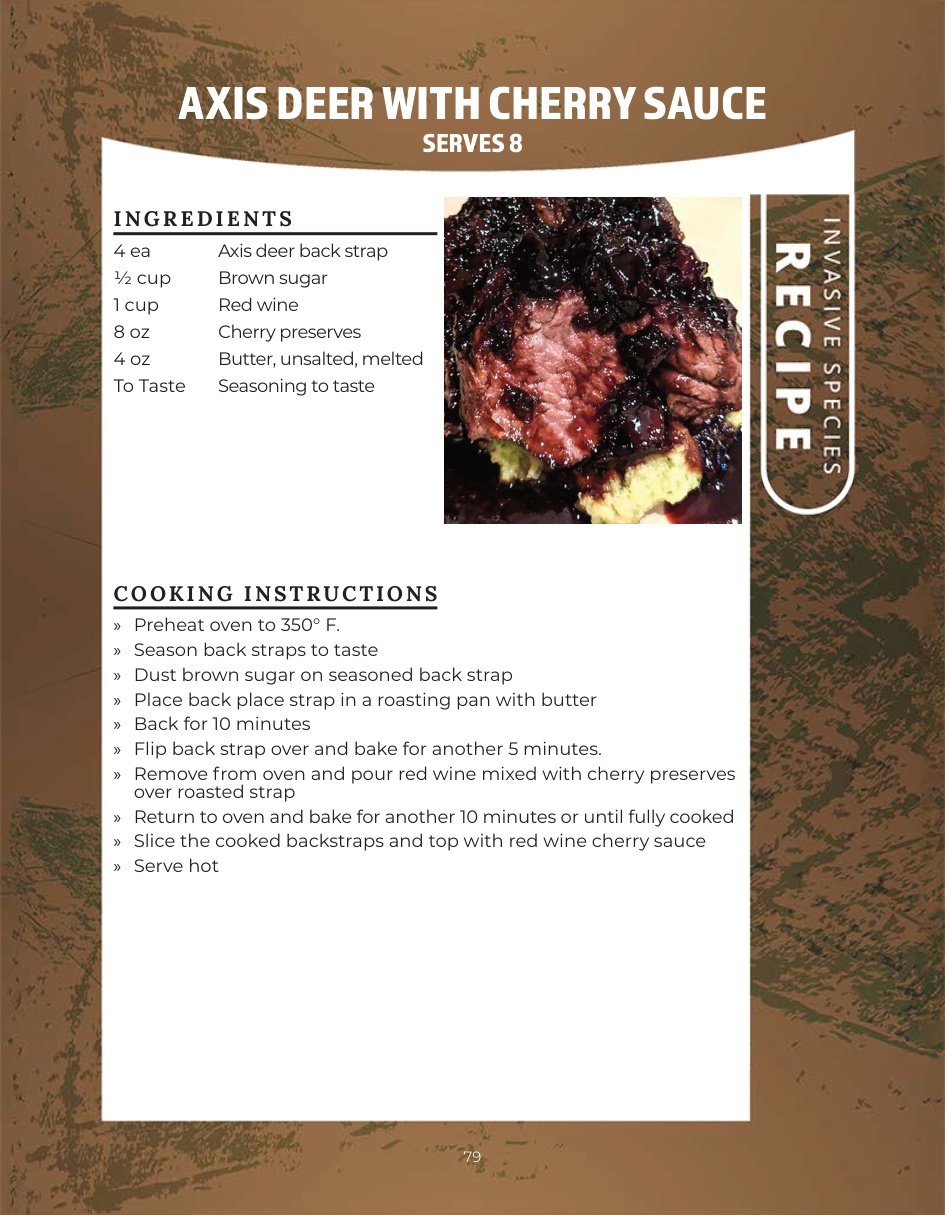
Axis Deer With Cherry SauceMammals · Book page 79Original recipe page: AXIS DEER WITH CHERRY SAUCE
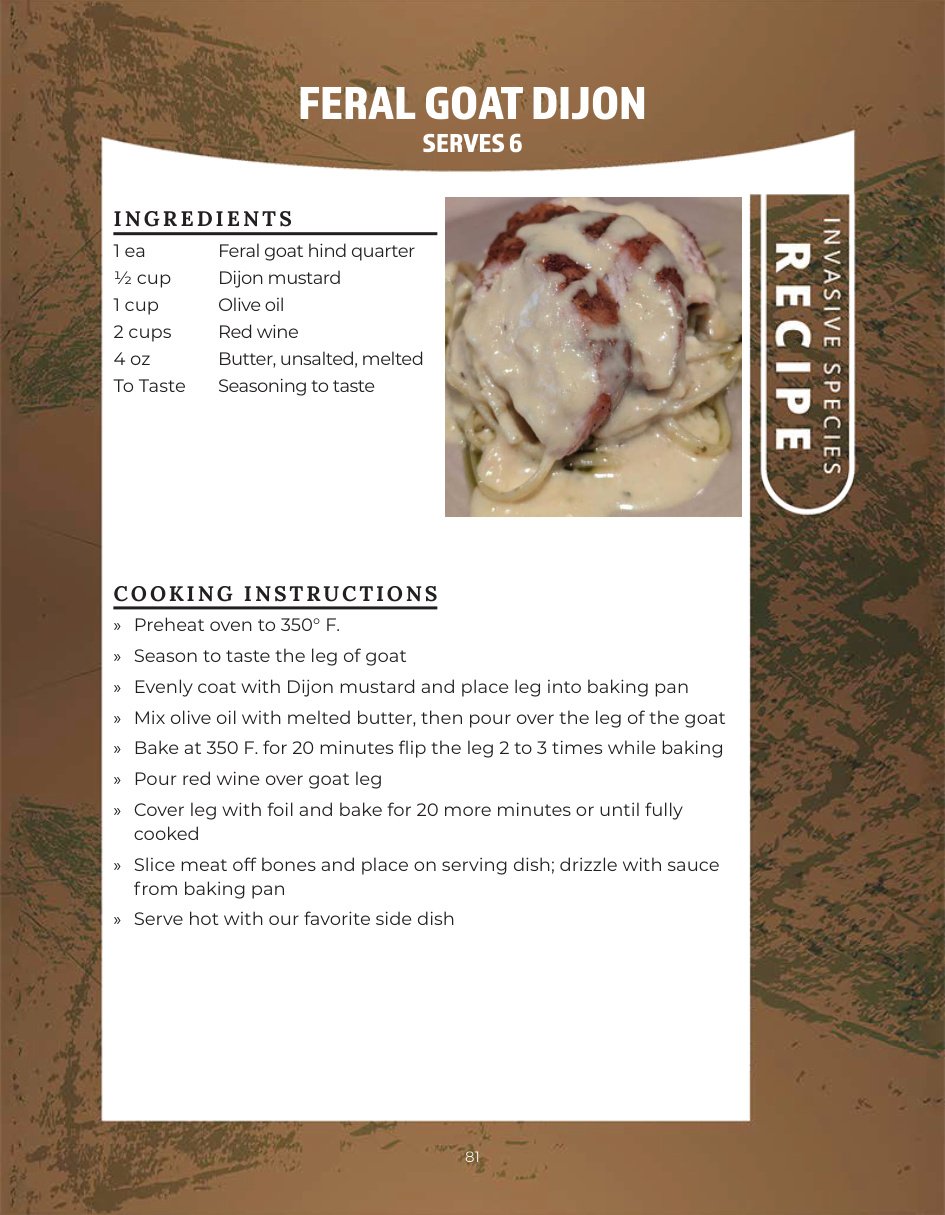
Feral Goat DijonMammals · Book page 81Original recipe page: FERAL GOAT DIJON
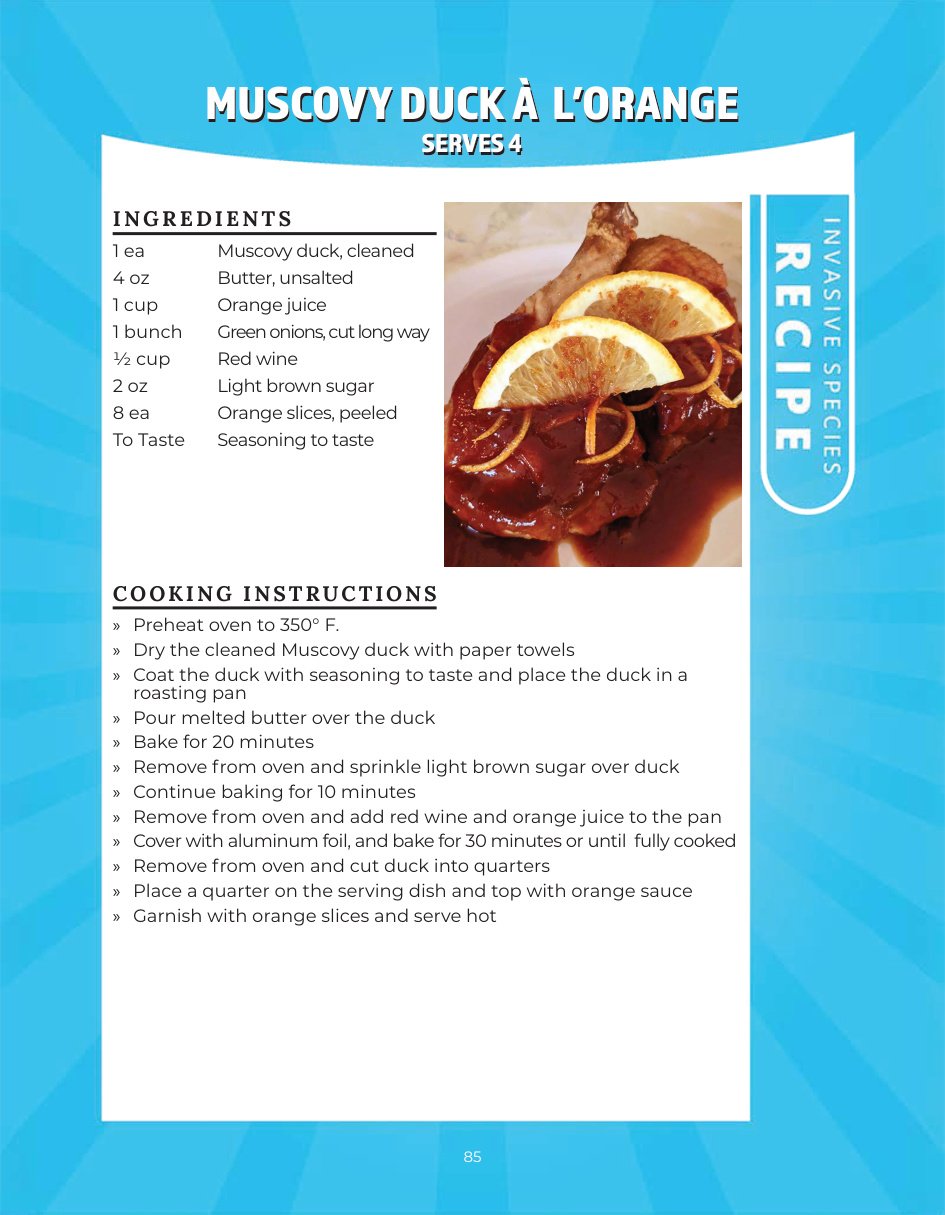
Muscovy Duck À L’OrangeBirds · Book page 85Original recipe page: MUSCOVY DUCK À L’ORANGE
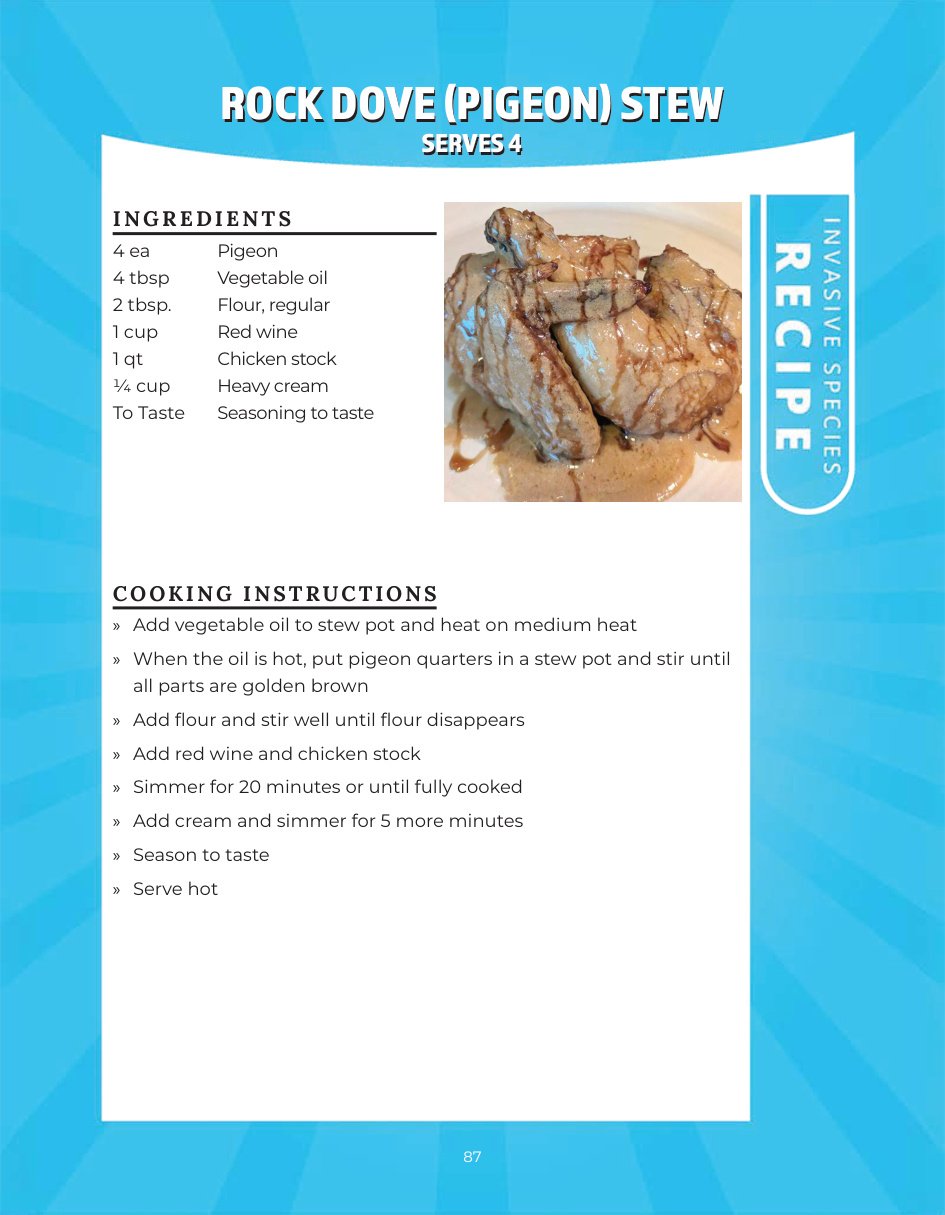
Rock Dove (Pigeon) StewBirds · Book page 87Original recipe page: ROCK DOVE (PIGEON) STEW
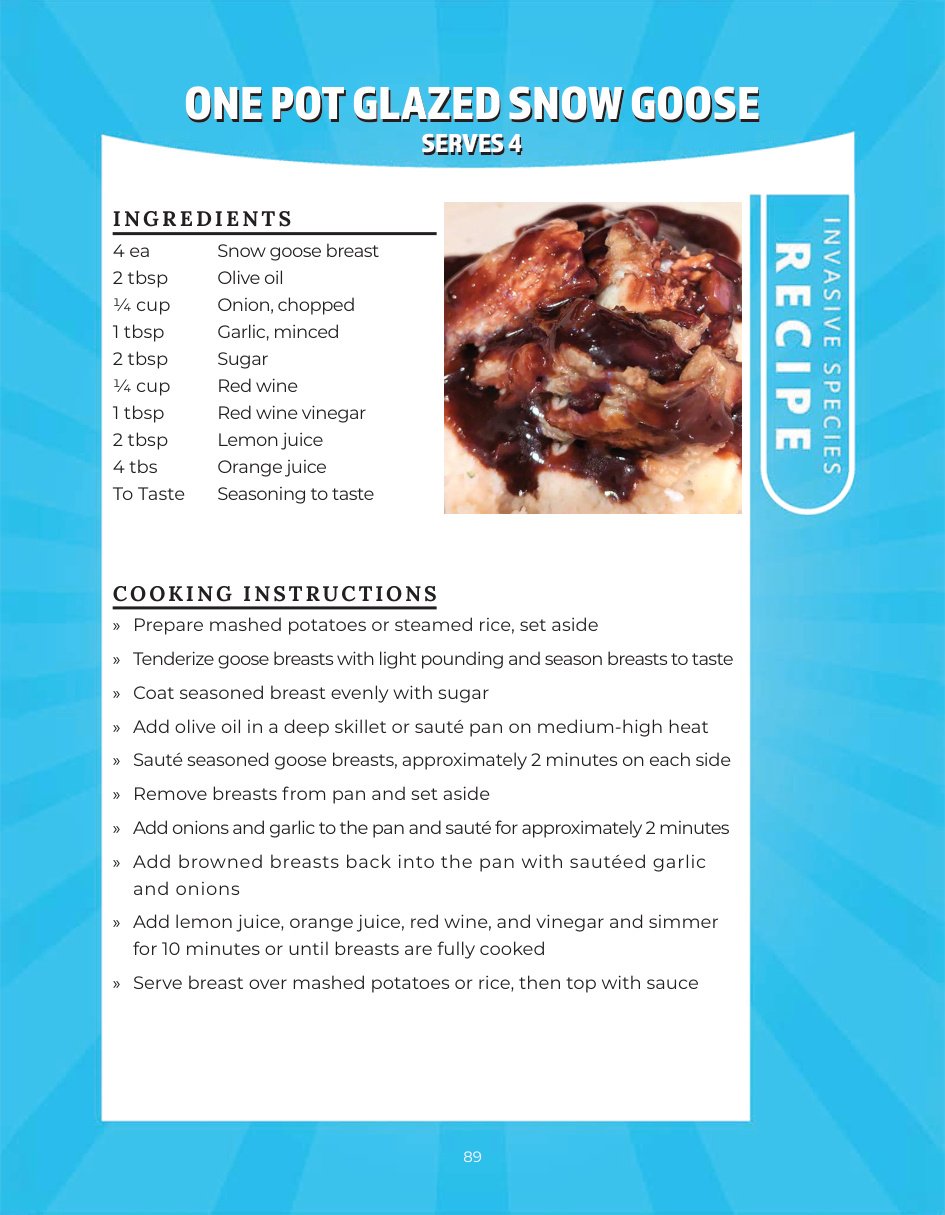
One Pot Glazed Snow GooseBirds · Book page 89Original recipe page: ONE POT GLAZED SNOW GOOSE
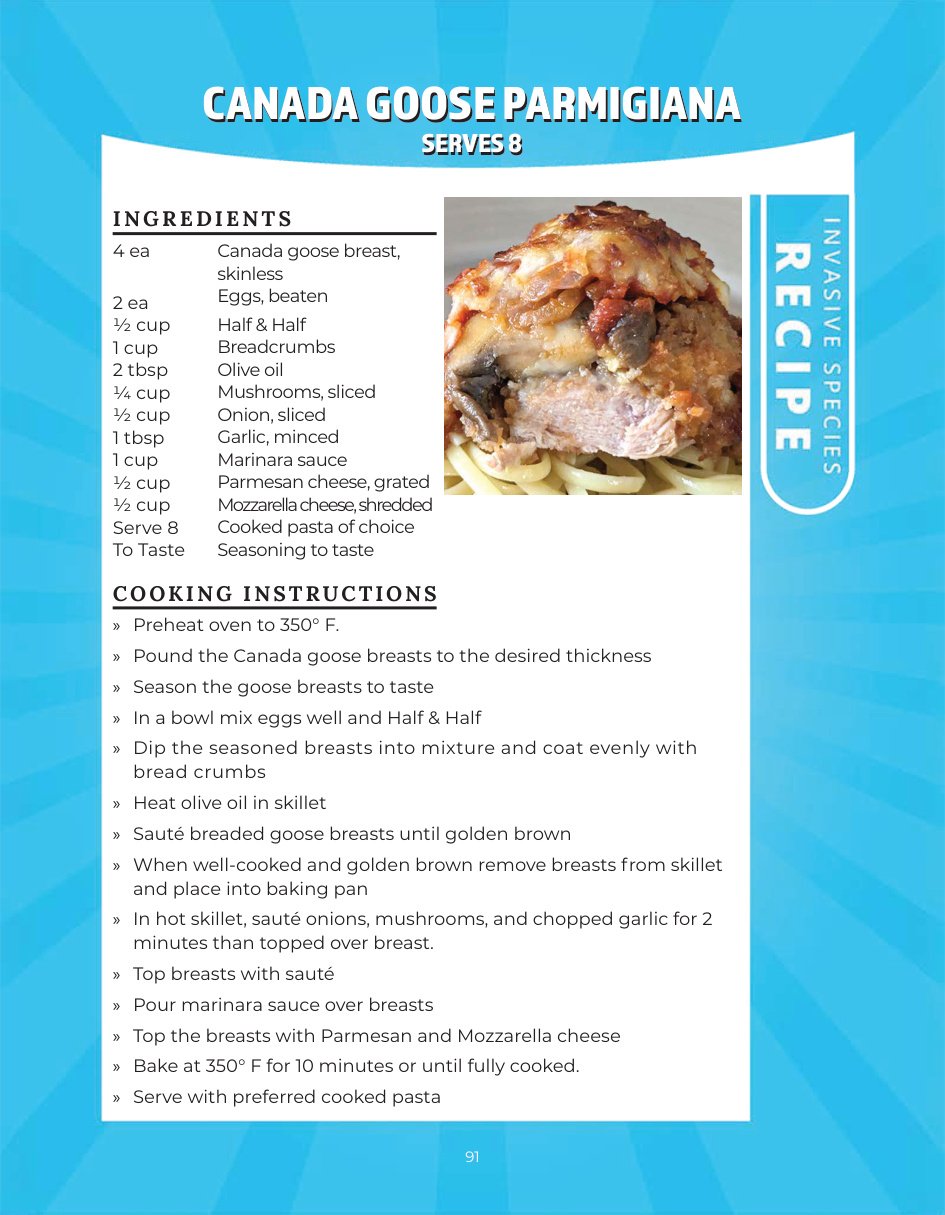
Canada Goose ParmigianaBirds · Book page 91Original recipe page: CANADA GOOSE PARMIGIANA
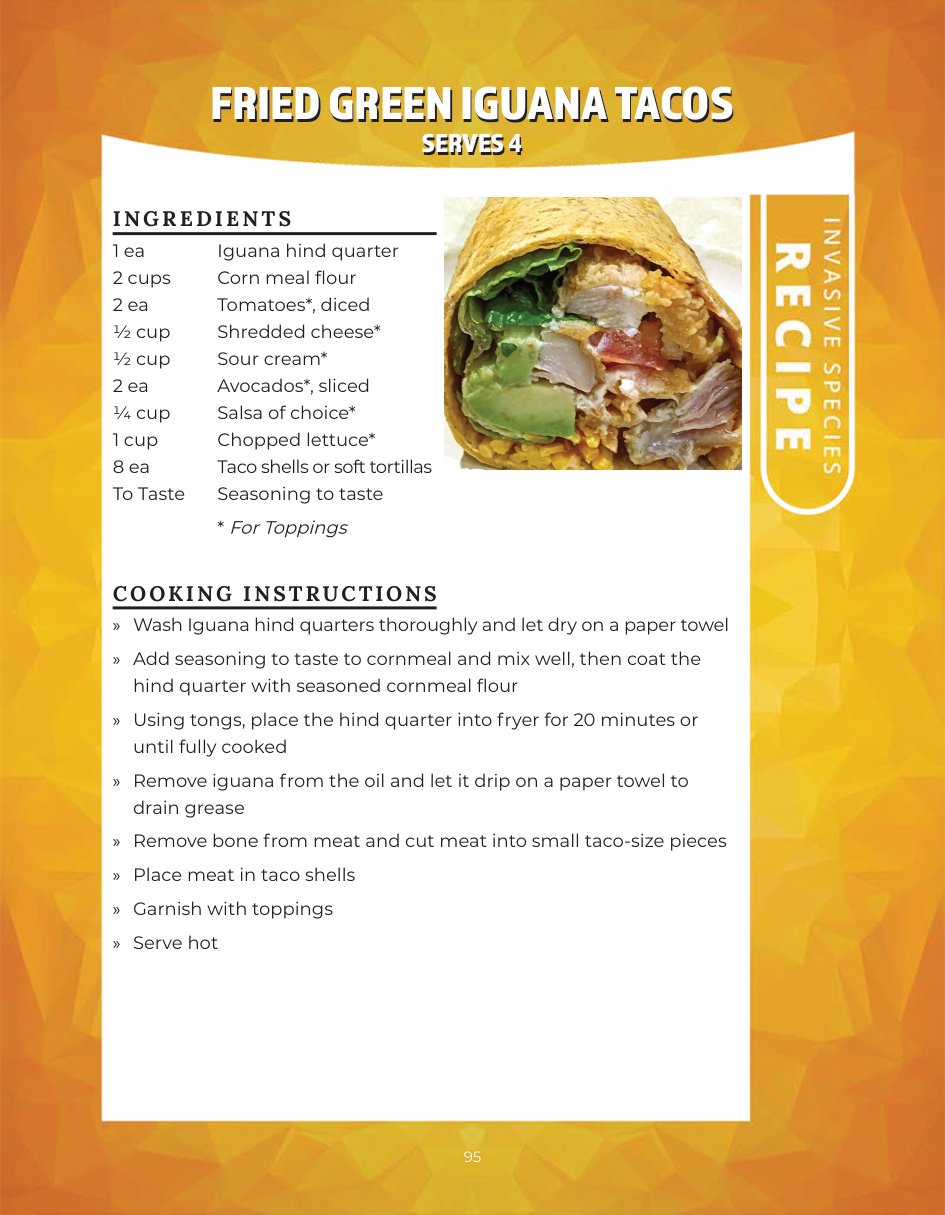
Fried Green Iguana TacosReptiles and amphibians · Book page 95Original recipe page: FRIED GREEN IGUANA TACOS
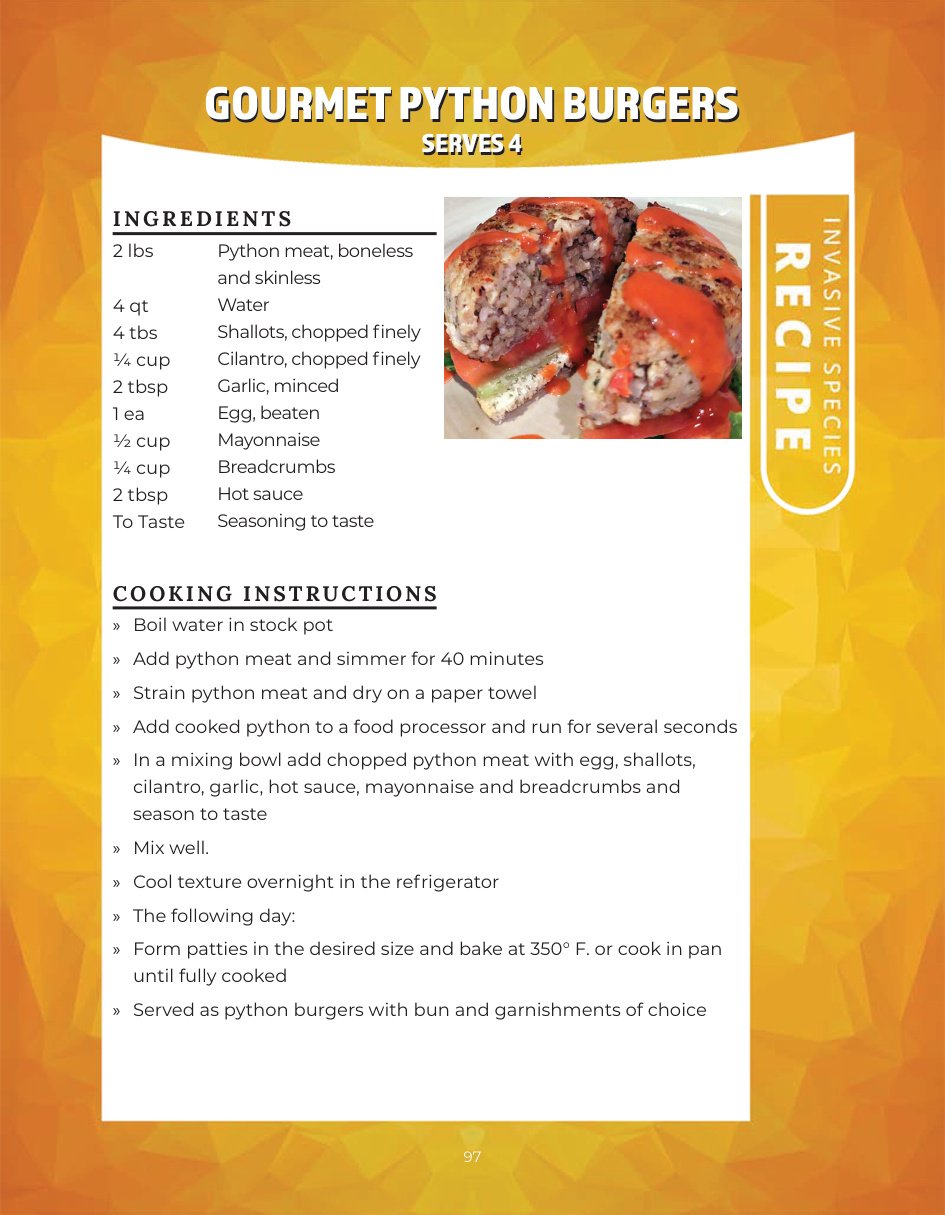
Gourmet Python BurgersReptiles and amphibians · Book page 97Original recipe page: GOURMET PYTHON BURGERS
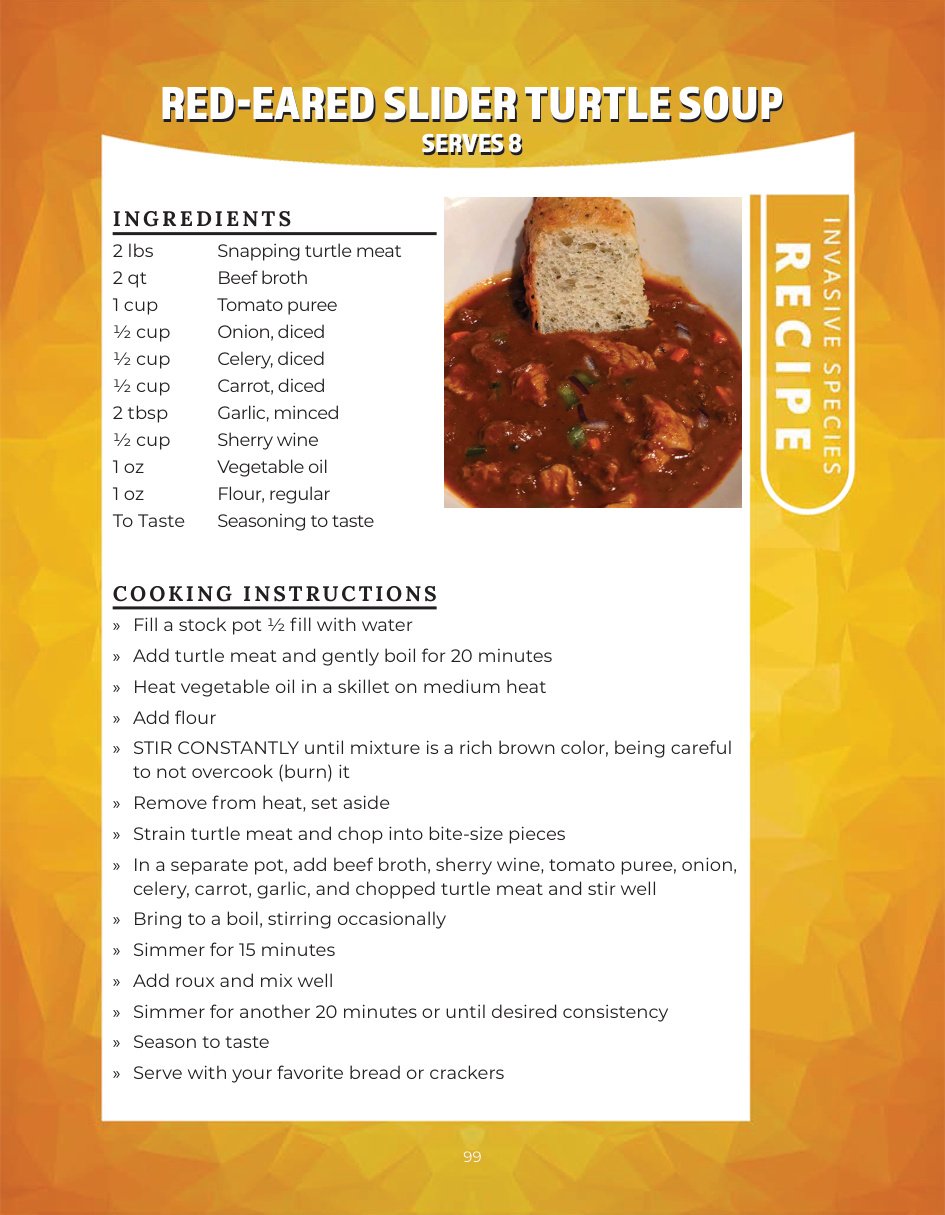
Red-Eared Slider Turtle SoupReptiles and amphibians · Book page 99Original recipe page: RED-EARED SLIDER TURTLE SOUP
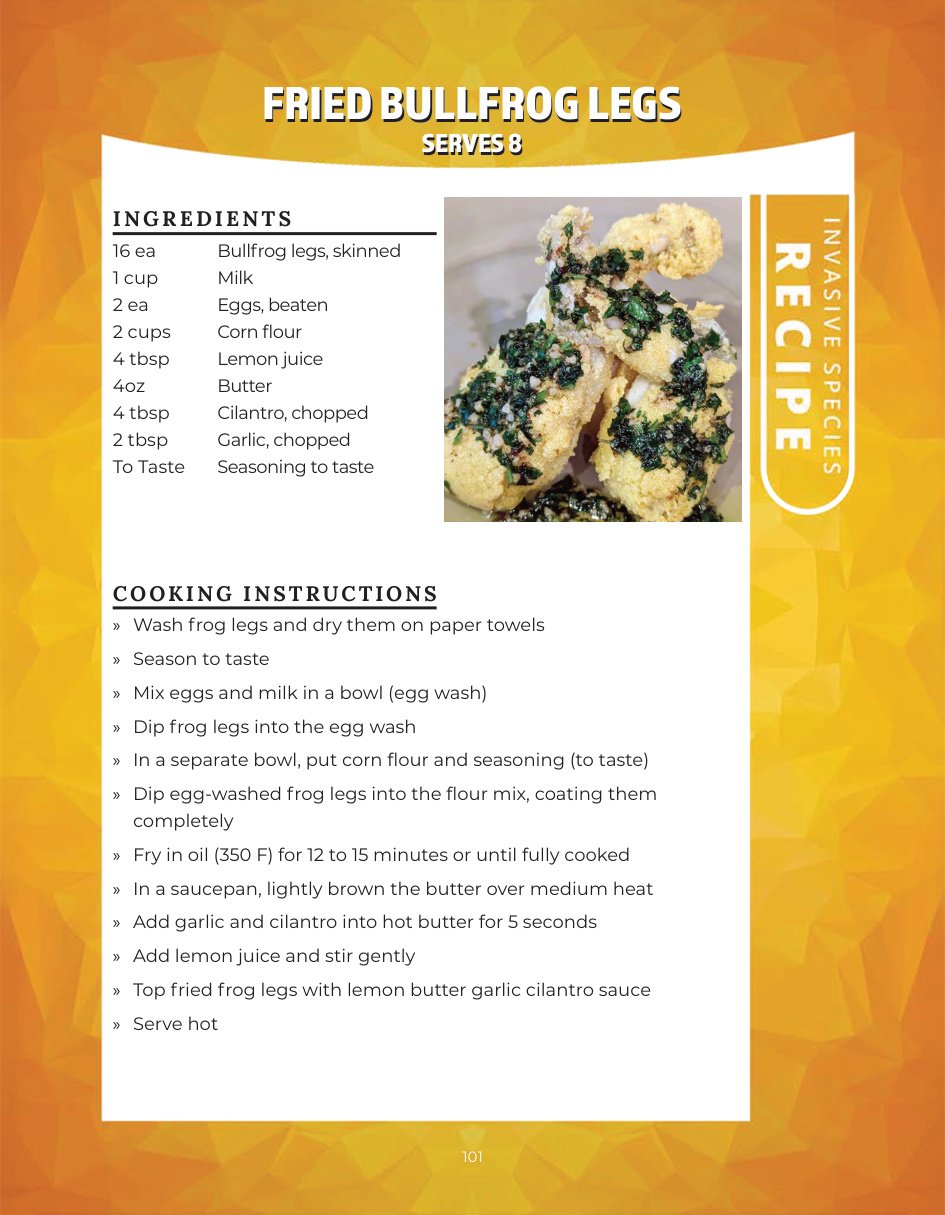
Fried Bullfrog LegsReptiles and amphibians · Book page 101Original recipe page: FRIED BULLFROG LEGS
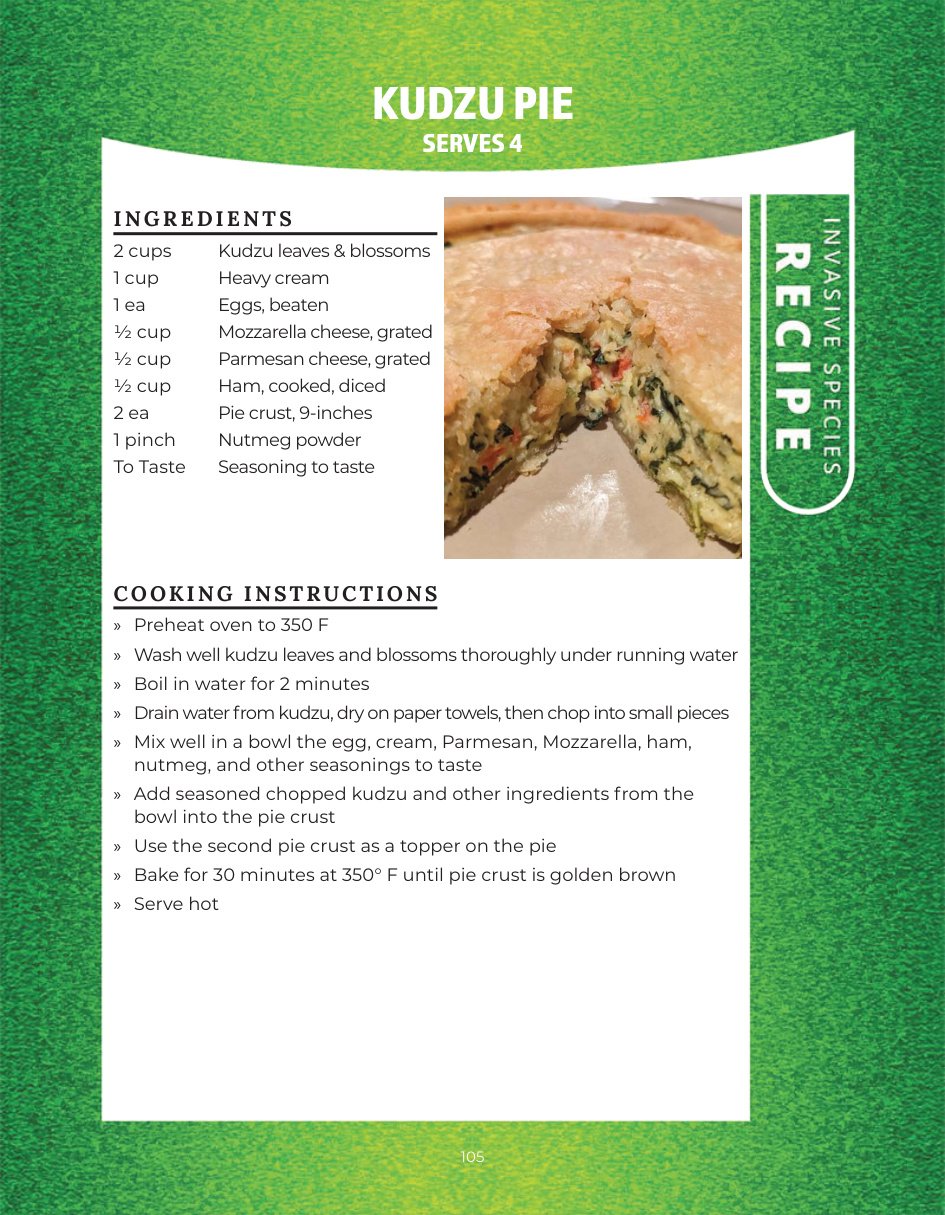
Kudzu PiePlants · Book page 105Original recipe page: KUDZU PIE
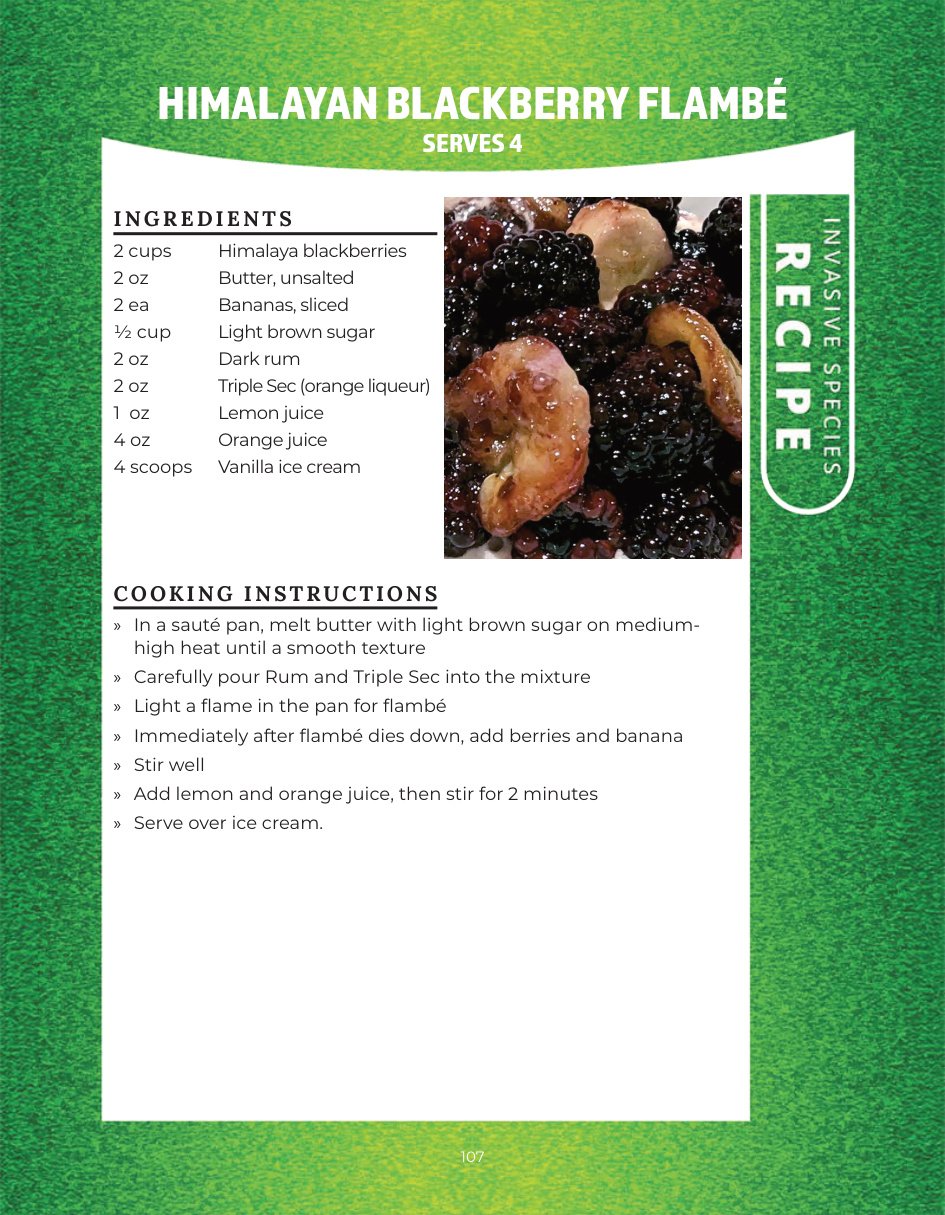
Himalayan Blackberry FlambéPlants · Book page 107Original recipe page: HIMALAYAN BLACKBERRY FLAMBÉ
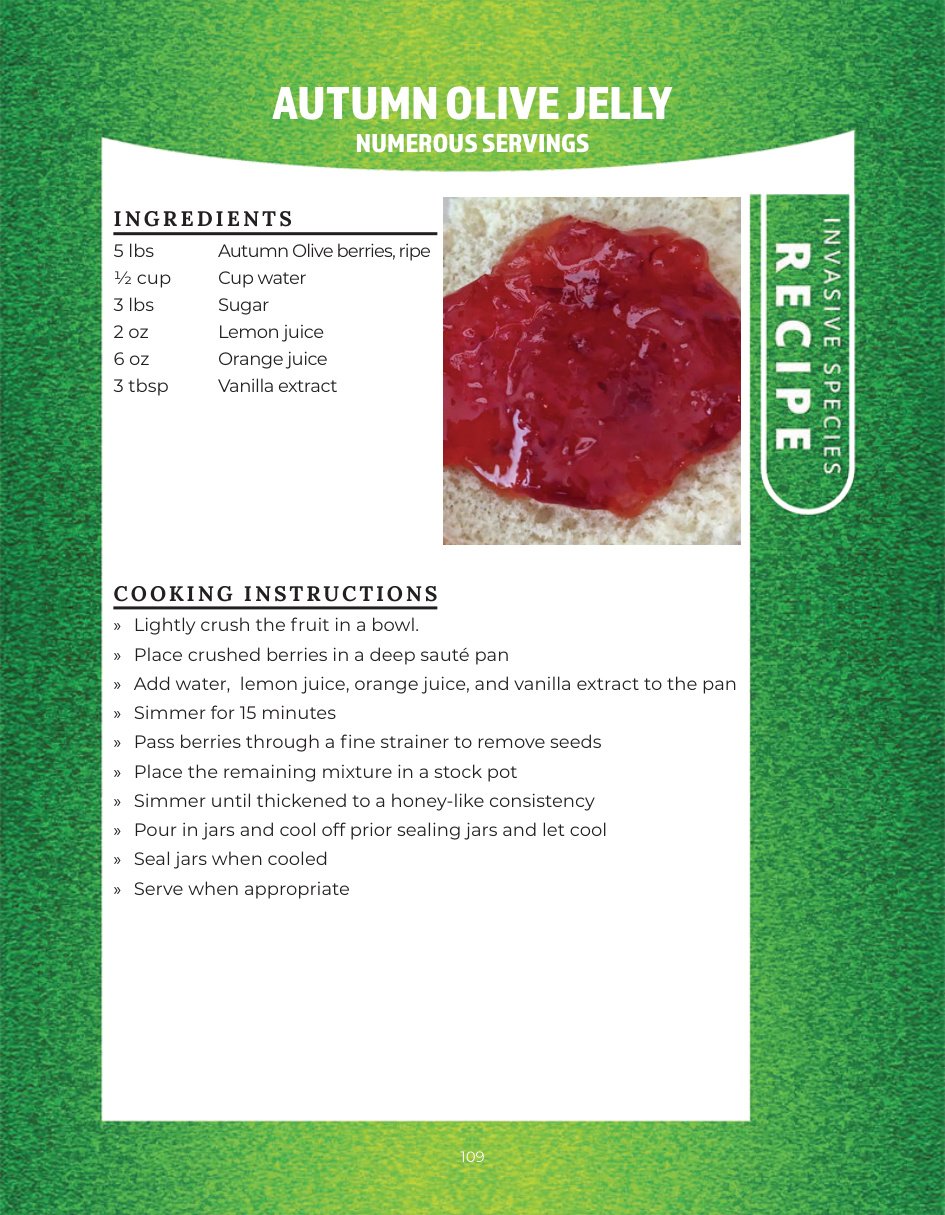
Autumn Olive JellyPlants · Book page 109Original recipe page: AUTUMN OLIVE JELLY
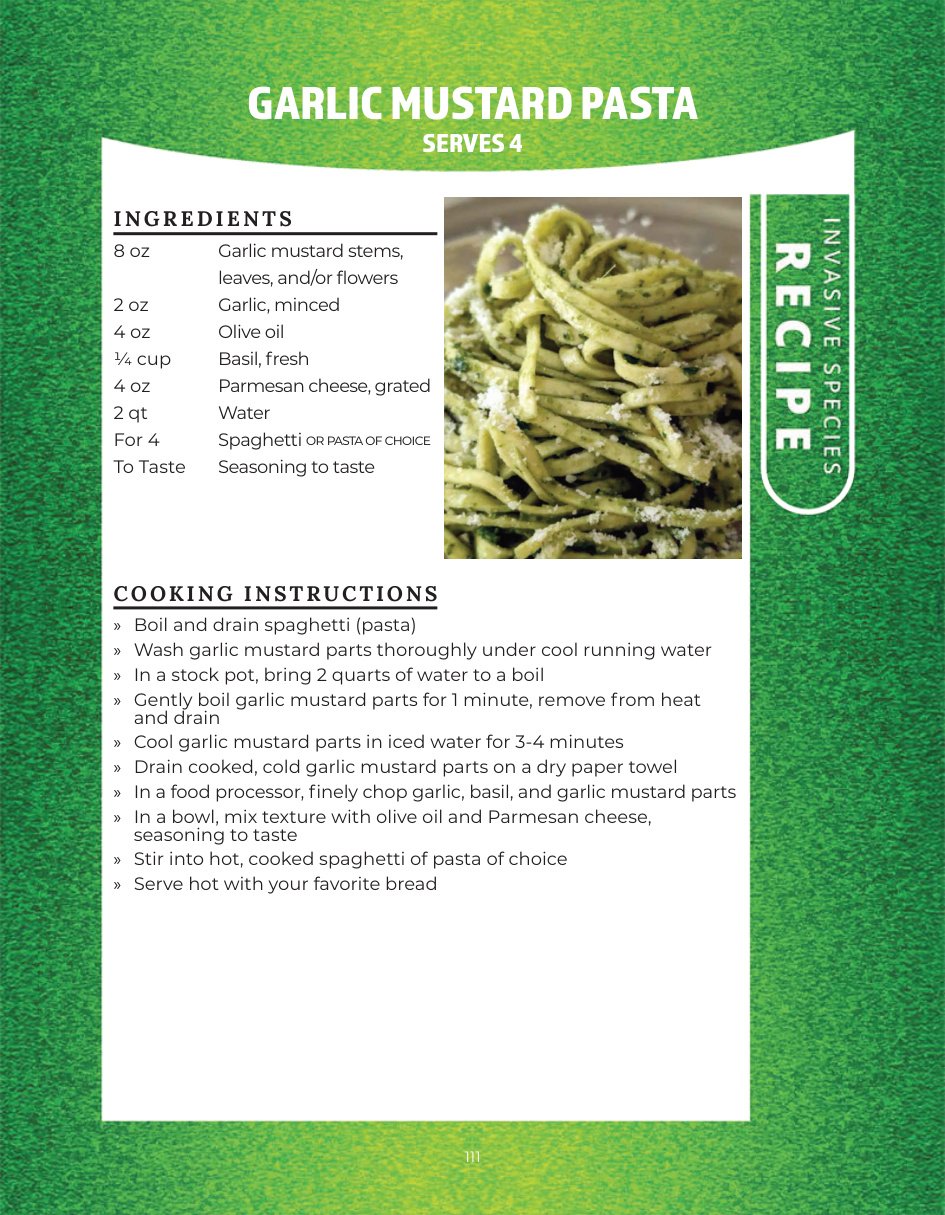
Garlic Mustard PastaPlants · Book page 111Original recipe page: GARLIC MUSTARD PASTA
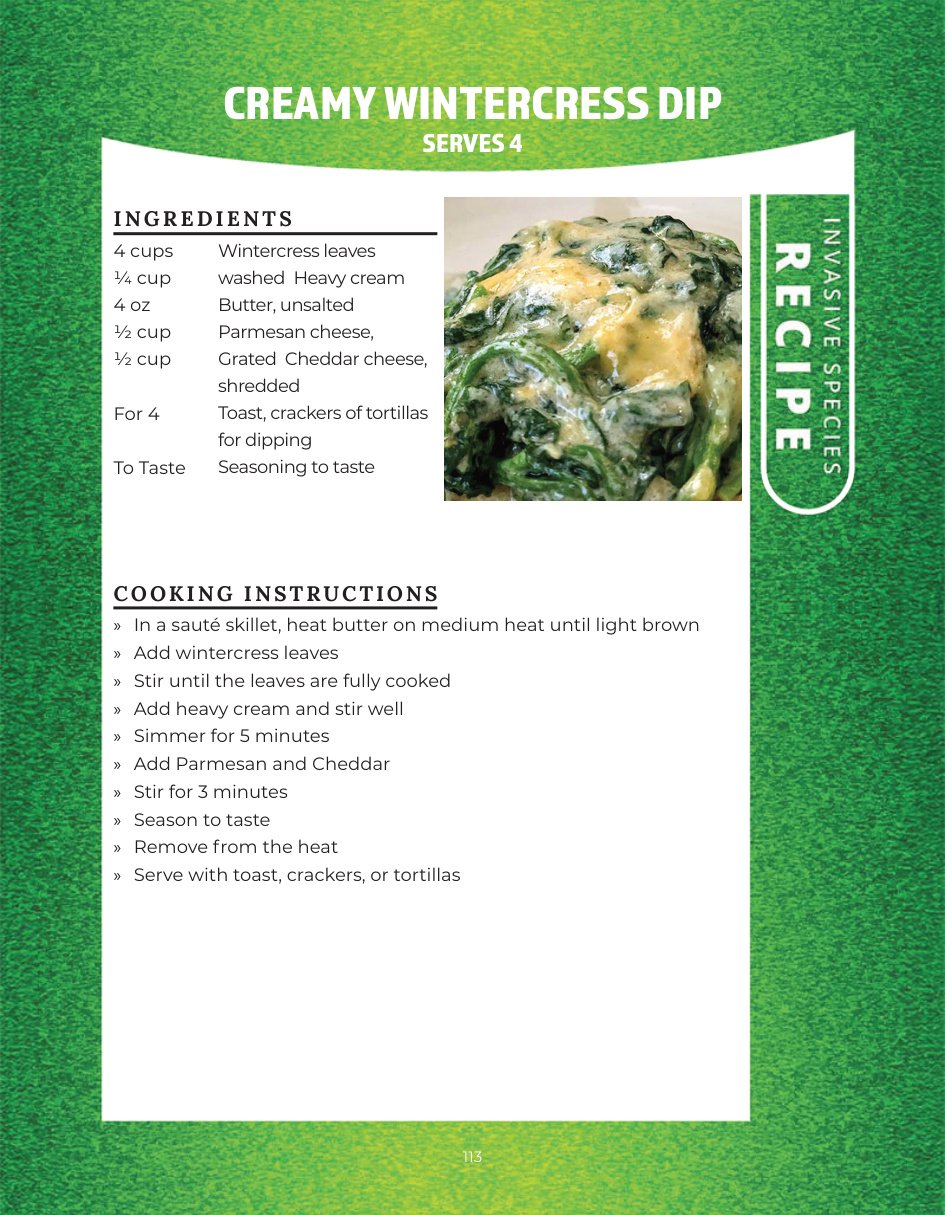
Creamy Wintercress DipPlants · Book page 113Original recipe page: CREAMY WINTERCRESS DIP
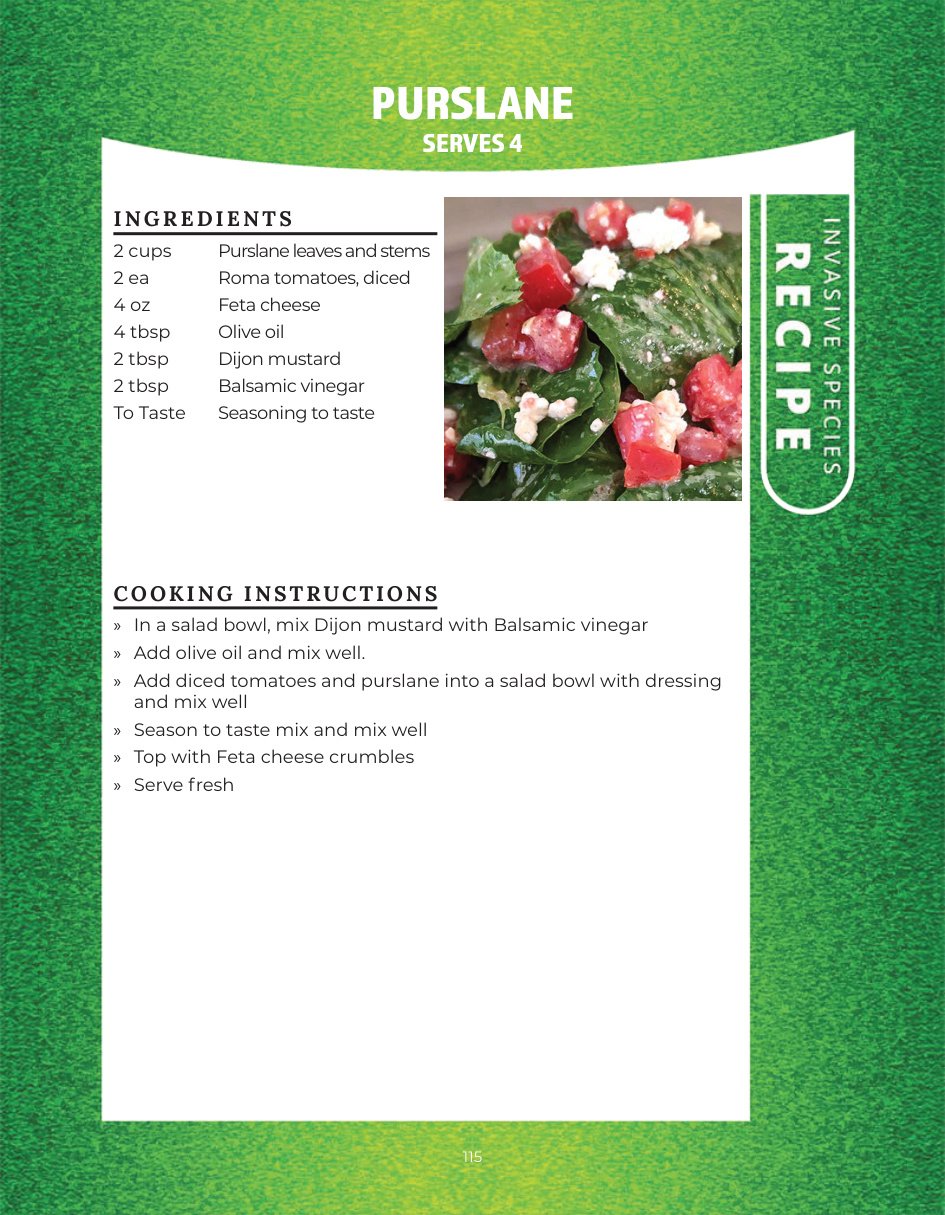
PurslanePlants · Book page 115Original recipe page: PURSLANE
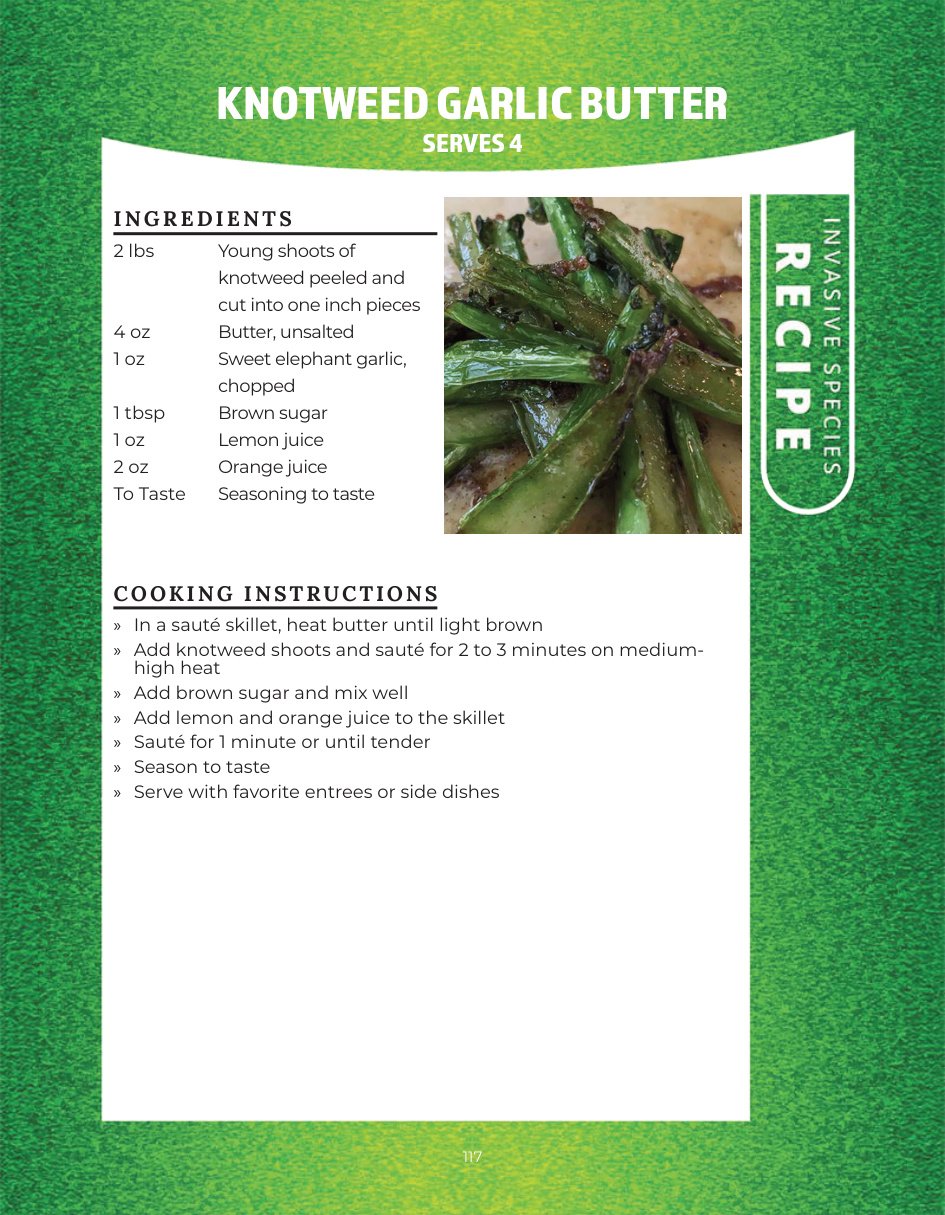
Knotweed Garlic ButterPlants · Book page 117Original recipe page: KNOTWEED GARLIC BUTTER
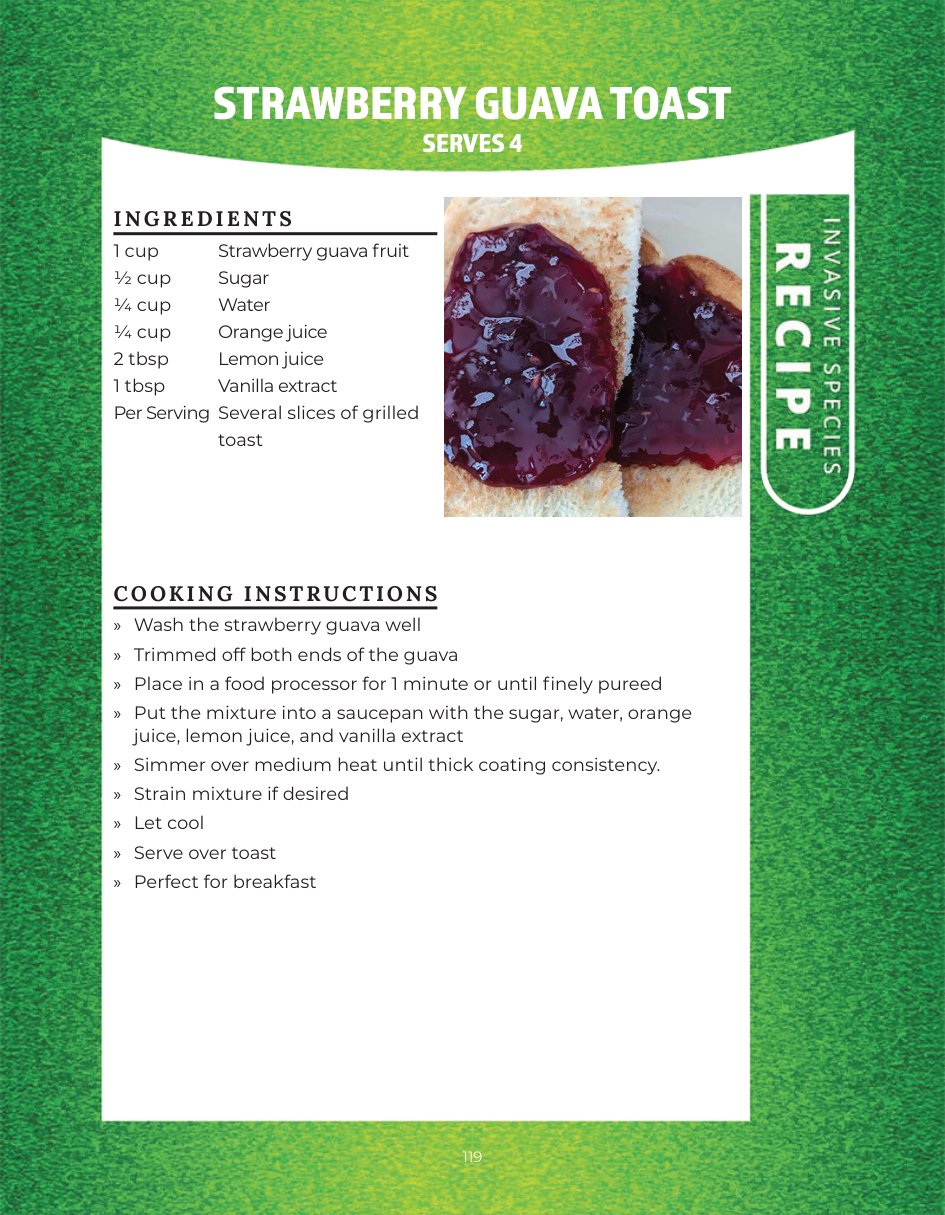
Strawberry Guava ToastPlants · Book page 119Original recipe page: STRAWBERRY GUAVA TOAST
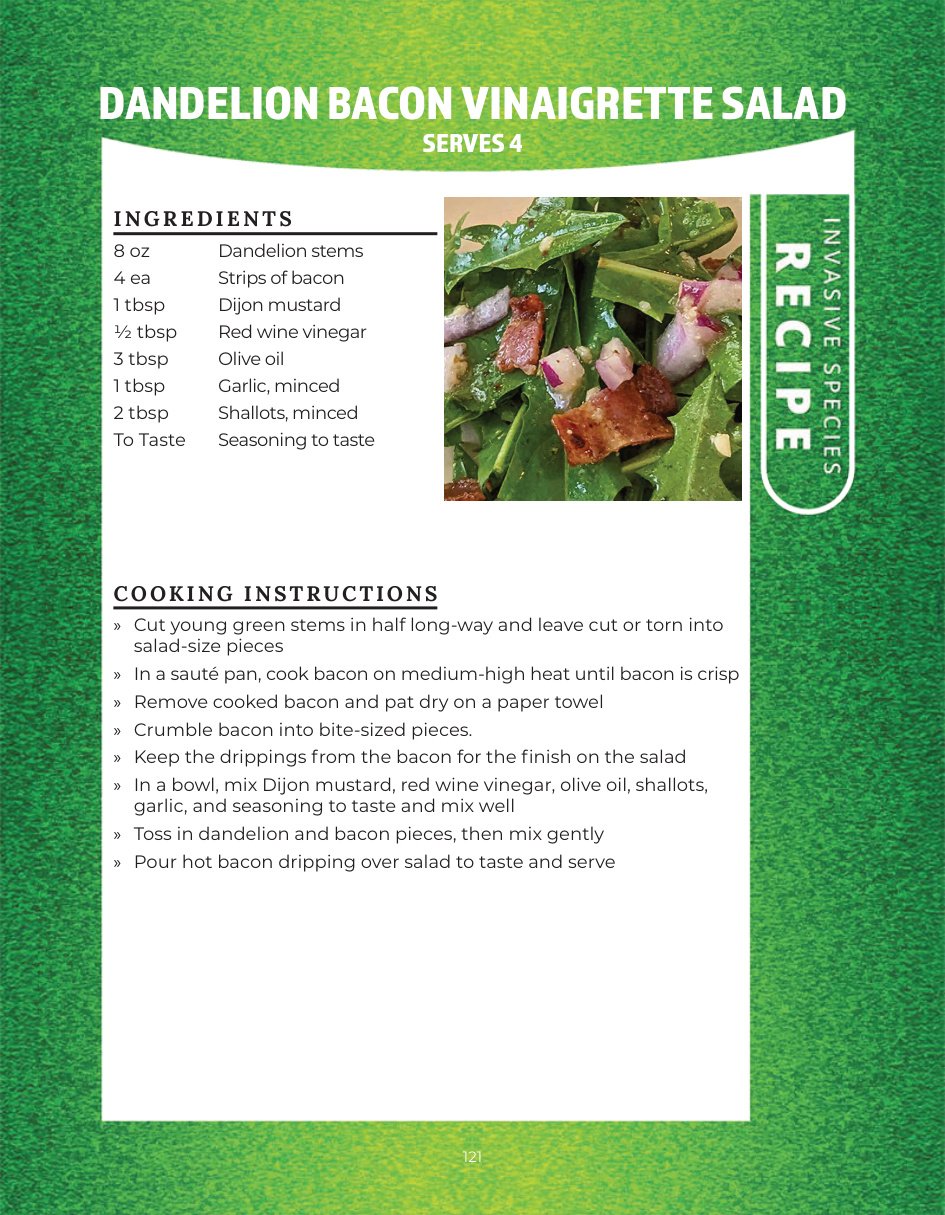
Dandelion Bacon Vinaigrette SaladPlants · Book page 121Original recipe page: DANDELION BACON VINAIGRETTE SALAD
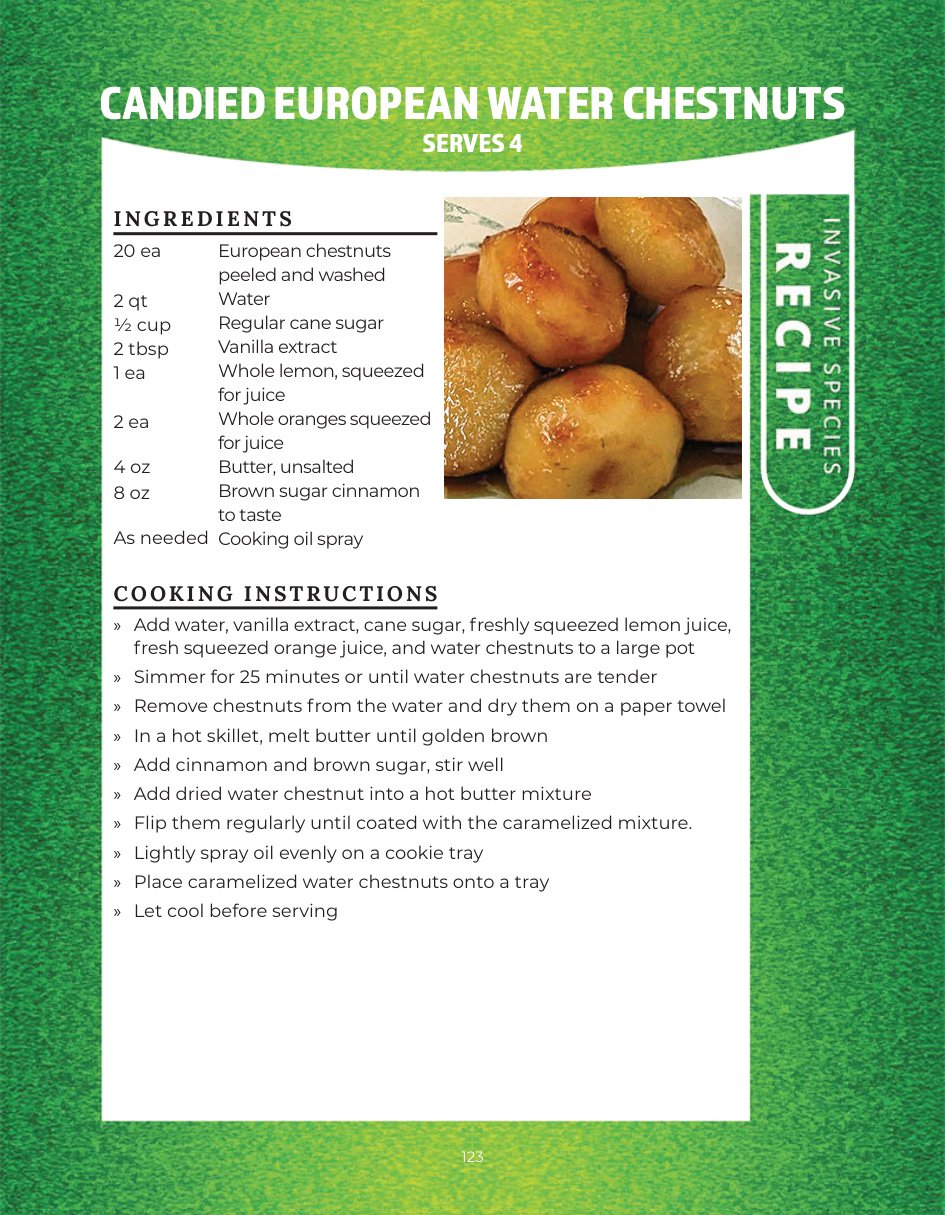
Candied European Water ChestnutsPlants · Book page 123Original recipe page: CANDIED EUROPEAN WATER CHESTNUTS
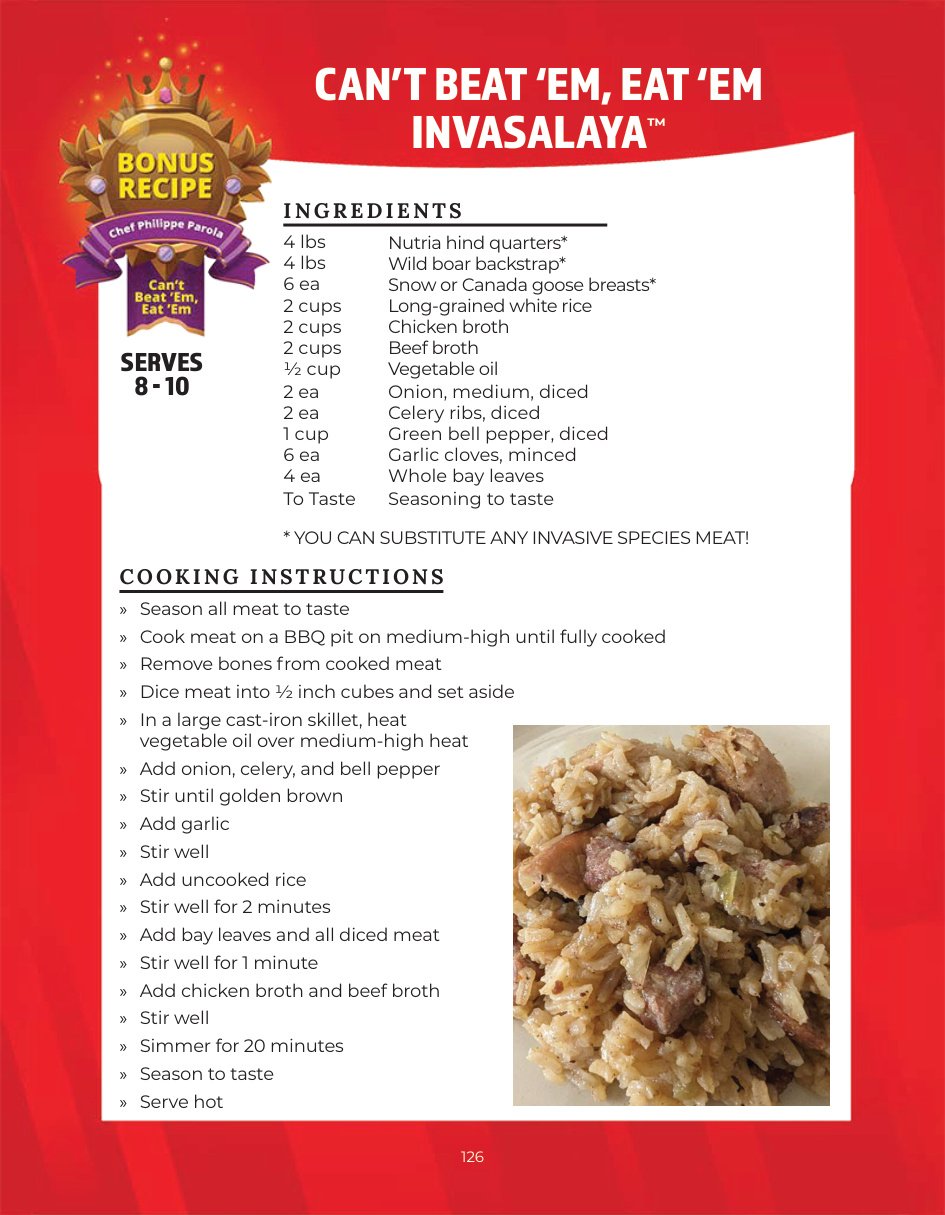
Can’T Beat ’Em, Eat ’Em InvasalayaMixed species · Book page 126Original recipe page: Can’t Beat ’Em, Eat ’Em Invasalaya
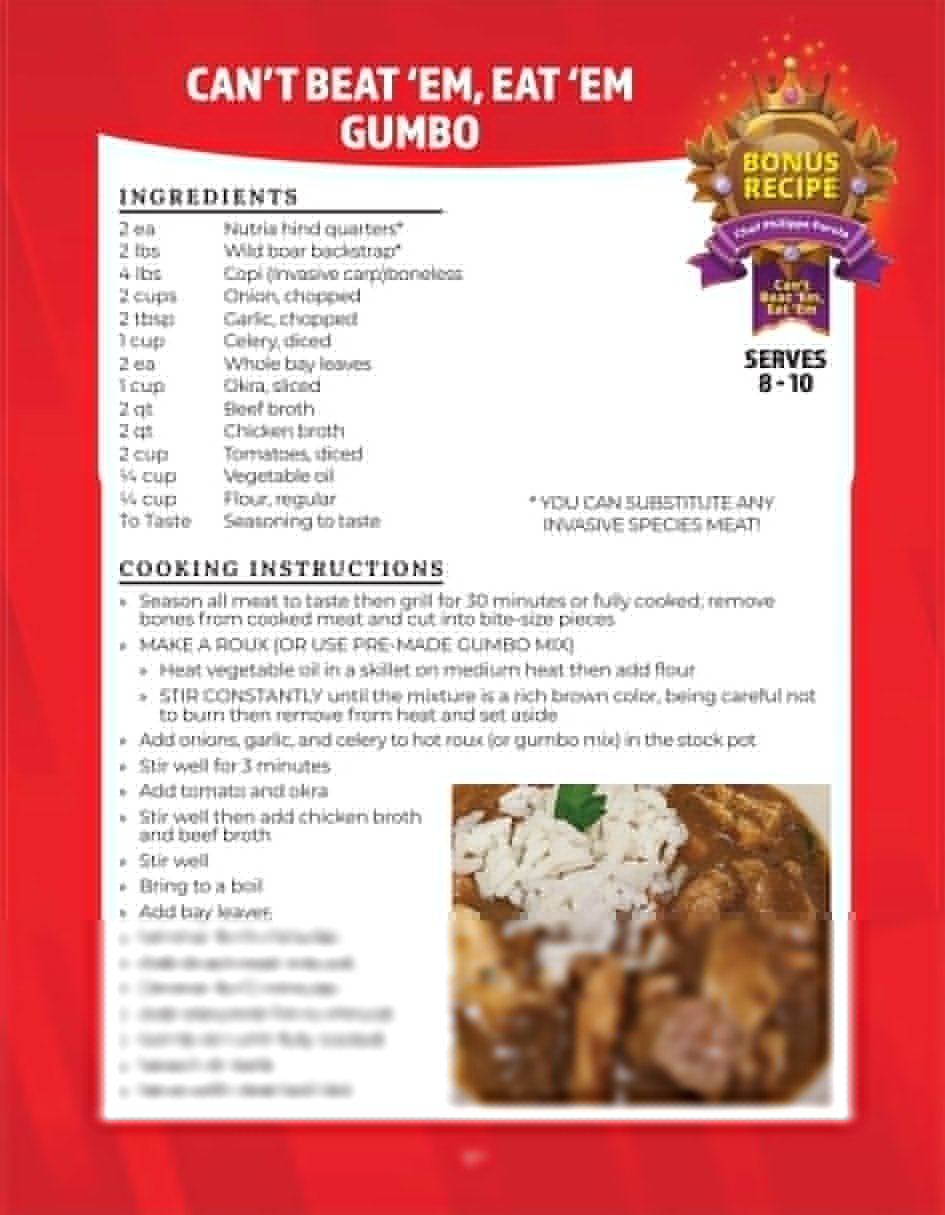
Can’T Beat ’Em, Eat ’Em GumboMixed species · Book page 127Original recipe page: Can’t Beat ’Em, Eat ’Em Gumbo

Follow the identification, safe handling, preparation, and cooking guidance in the book. Copyright © 2023 Chef Philippe Parola. Original credits remain on the pages.

See the mission in action

Watch. Discover. Share.

Three videos carried forward from the existing Can’t Beat’em, Eat’Em website.

Videos require an internet connection. If a player does not load, use its YouTube link.

More stories in the media

Gulf Seafood News — Nutria gumbo and Louisiana’s wetlands ↗

Salon — Chef Philippe’s early invasive carp work, 2010 ↗

Can’t Beat’em, Eat’Em

Our advisory board.

Chef Tim Creehan

Tim Watson

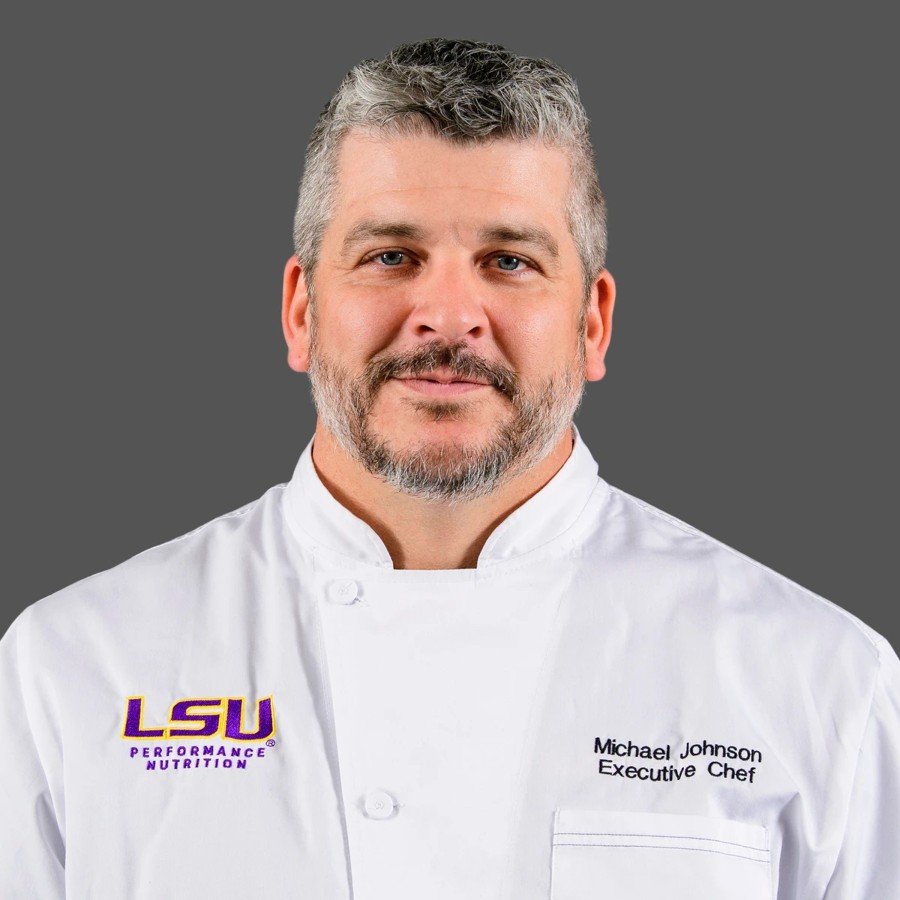
Chef Michael Johnson

Ewell Smith

Dennis Riecke

Roy Brabham, M.D.

Work with Chef Philippe

Experience that moves
ideas toward opportunity.

Practical guidance for ecological food projects

Chef Philippe brings a culinary and market perspective to projects that turn edible invasive species into useful products.

Areas of collaboration

  • Culinary product development and recipe concepts.
  • Copi fish cakes, sliders, patties, and food-service applications.
  • Processing concepts and product-flow planning with technical partners.
  • Product positioning and invasive-species storytelling.
  • Institutional buyer outreach and menu-development support.
  • Exploration of byproduct markets and potential partners.
  • Public education and project presentations.

Chef Philippe serves as a consultant to owners and operators. Scope, deliverables, and compensation are established for each engagement.

Discuss your project

Book Chef Philippe for your next event

Making a difference one bite at a time!

Chef Philippe connects the challenge of invasive species with the creativity of the kitchen. His presentations introduce audiences to the Can't Beat'em, Eat'Em movement and explore how food, education, and market development can contribute to ecological action.

Presentation topics

  • Can't Beat'em, Eat'Em: the movement and the book.
  • Copi: turning invasive carp into culinary opportunities.
  • Bringing ecological purpose to campus and institutional dining.
  • Developing products and markets for edible invasive species.
  • Connecting responsible harvest with culinary innovation.

Suitable audiences include universities, culinary programs, food-service organizations, environmental groups, industry conferences, and community events.

Presentations, discussions, and culinary demonstrations can be discussed according to the event's goals and facilities.

Book a presentation
Our mission and responsible sourcing

Turn an environmental challenge into a useful resource

Our mission is to educate the public about invasive species, demonstrate the culinary potential of suitable edible species, and help develop practical markets that support responsible harvest.

  • Educate: Explain how invasive species affect native habitats and biodiversity.
  • Create: Develop recipes and food concepts that make unfamiliar ingredients approachable.
  • Connect: Bring together harvesters, processors, buyers, educators, and project partners.
  • Support responsible removal: Encourage sourcing from invaded areas as part of broader population-management efforts.

The movement promotes harvesting existing invasive populations where they cause harm. It does not encourage introducing, spreading, or farming invasive species.

Let’s make a difference together

Start a conversation.

Consulting, speaking, Copi products, book orders, partnerships, and media inquiries.

Chef Philippe Parola

Ecological Culinary Innovator
Book Author · Consultant · Speaker

225 315 5111
chef@chefphilippe.com

Email Chef Philippe
Enlarged illustration